Dryer Vent Installation in Somerville, NJ
Dryer vent installation builds a new exhaust path from the dryer to a cap outside the house, in rigid metal duct along the shortest route the framing allows. AMG Duct Cleaning Somerville NJ installs vents for new and relocated laundry rooms and rebuilds runs that were put in with the wrong material or too many turns.
Plenty of dryer vents around Somerville were assembled rather than designed. A laundry moved up from the basement during a remodel, a second dryer added when a house became a two-family, a vent extended through a finished basement ceiling: each can leave a run with extra elbows, foil hose inside a wall, or a cap in a poor spot. The Consumer Product Safety Commission's guidance favors rigid or corrugated semi-rigid metal over plastic or foil accordion duct, noting that most dryer makers call for metal and that the flexible kind traps lint and crushes easily.
The newer houses in the townships bring their own layouts. An upstairs laundry in a Hillsborough, Branchburg or Montgomery house runs up into the attic and out through a roof jack or a gable end, the longest run a dryer is asked to push. A Franklin townhouse may vent through a chase to the roof, with the association deciding what can change on the outside of the building. Every installation starts by walking the possible routes and choosing the one with the fewest bends.
Which route and which duct should a dryer vent use?
The best route is the shortest, straightest one to an outside wall or the roof, since each elbow slows the air and hands lint another corner to collect in. The dryer's installation instructions set the limits on length and fittings for that model, and the route is planned inside them. The run is rigid metal duct with a smooth interior, supported so it stays straight, with joints fastened and sealed with foil tape rather than screws that poke into the airstream and catch lint.
Length matters because the dryer's blower can only push so far. A route that looks convenient but snakes around joists leaves the dryer running long on every load, so the shortest path is worth some extra work, even if that means opening a ceiling or cutting a new wall opening. Flexible duct appears in one place only, the short transition from the dryer to the wall, and that piece is semi-rigid metal, not foil, kept as short as the dryer's position allows and never shoved into a crushed loop when the machine is pushed back.
Where should the vent end outside the house?
Outside, the run ends in a hood whose damper flap swings open when the dryer pushes air and falls shut when it stops, keeping out rain, cold air, birds and rodents. Screens have no place on a dryer cap, since lint catches on them and seals the opening. The cap goes clear of doors, windows and air intakes, high enough to stay above snow and mulch, and where the exhaust will not pile lint against a deck or the house next door. On a two-family house or a narrow lot, the crew also checks that the new cap will not blow lint toward a neighbor's window or into a side passage.
On the older houses of Somerville, Rocky Hill and Millstone, where the facade and trim are part of the house's character, you see the cap location before anything is cut, and a side or rear wall is chosen where one works. On a roof, a dryer roof jack with a flap is used and flashed into the roofing so the opening stays watertight.
How are long, upstairs and multi-unit runs handled?
An upstairs laundry with a roof termination is the hardest run to keep clear, so the route through the attic is as direct as the framing allows, and the attic section is insulated where cold air would otherwise condense moisture inside the duct in winter. If no route fits the dryer maker's limits, the choices are a different wall, a straighter path, or, when nothing else works, a booster fan matched to the run, and the crew tells you which applies before quoting.
In a two-family house in Manville or Raritan, each dryer gets its own run to its own cap, never a shared duct. In a townhouse or condominium, the building or the association often decides whether a new opening is allowed, so AMG works with the management office, sends a certificate of insurance when the association asks for one, and works inside the building's access rules.
What does an installation visit include?
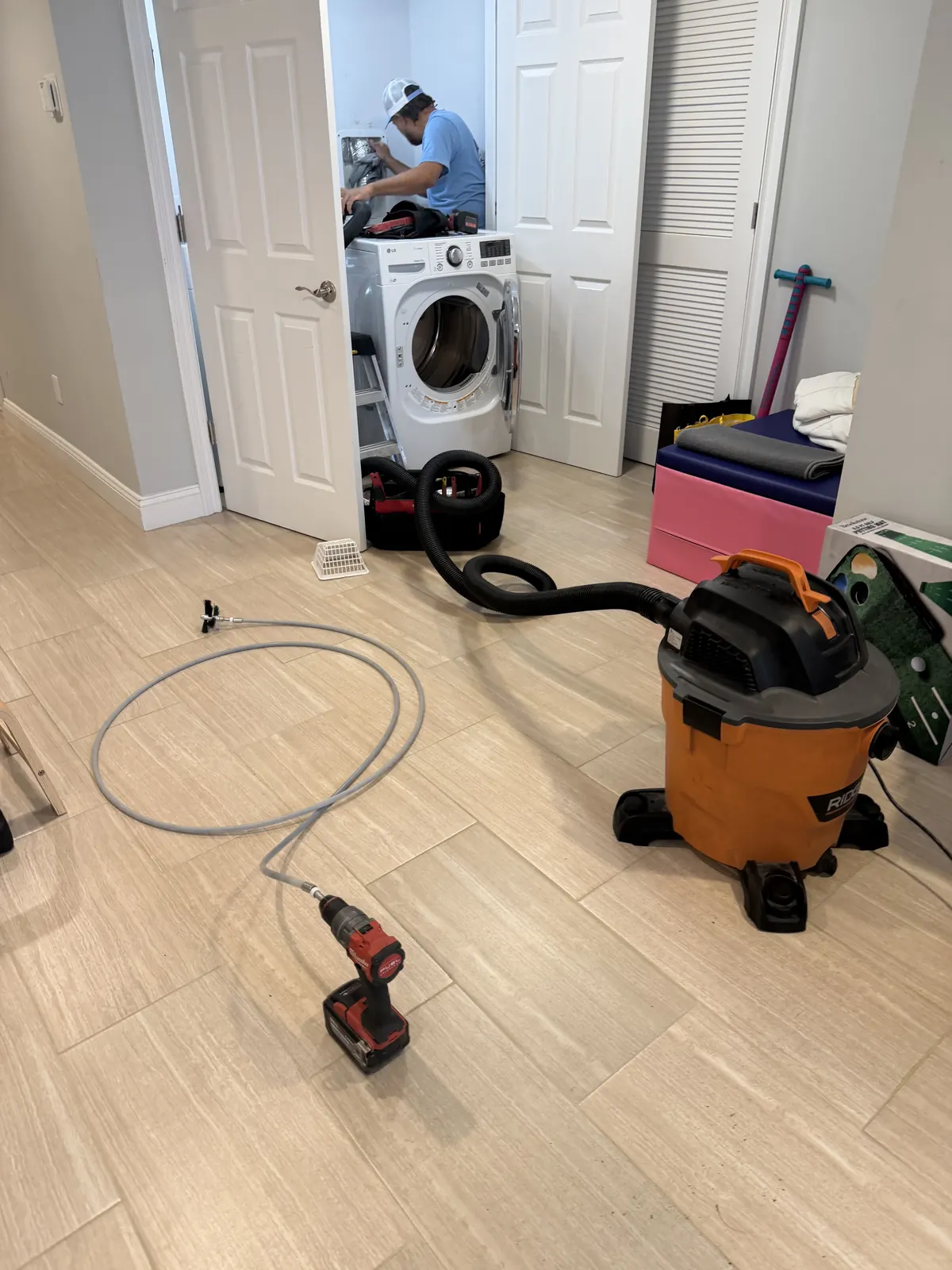
The crew walks the planned route with you, marks the openings, protects the floor and the laundry area, and takes out the old run if there is one. Once the new duct is in, the old opening is closed and sealed, the dryer is reconnected, and the crew runs it to confirm that air leaves the cap with the flap opening fully.
The free estimate covers the route and where the cap will go. You can book an installation 8 AM to 8 PM, 7 days a week with AMG, a licensed and insured contractor (NJ HIC 13VH13654300) that is veteran owned. A cleaning visit that finds the route itself at fault often turns into the plan for a new one, and when a laundry room is part of a larger remodel anywhere in the towns we serve, air duct installation for the new space can happen while the framing is open.
What is included
- A route out through a wall or the roof with as few bends as the framing allows
- Rigid metal duct for the run, supported so it stays straight
- Semi-rigid metal transition between the dryer and the wall
- Joints fastened and sealed with foil tape, with no screws into the airstream
- Hood with a working damper flap and no screen
- Cap placed clear of doors, windows, air intakes and the snow line
- Old run removed and the unused opening closed and sealed
- Airflow checked at the cap with the dryer running
Questions and answers
Who installs dryer vents in Somerville, NJ?
AMG Duct Cleaning Somerville NJ installs and reroutes dryer vents for houses in Somerville, Raritan and Manville, in Branchburg, Hillsborough and Montgomery, and in Franklin, Millstone and Rocky Hill, using rigid metal duct and a damper cap. The route is walked with you at the estimate, before anything is cut.
Can the vent come out a different wall?
Usually, and moving it is often the cleanest fix for a run with too many turns. The crew looks for a shorter, straighter route, patches the old hole, and installs a new cap with a damper. In a condominium or townhouse community, the association may need to approve a new opening first.
What kind of duct should a dryer vent use?
Rigid metal for the run, with a short semi-rigid metal transition behind the dryer, which is also what most dryer makers call for. Plastic and foil accordion hose trap lint and crush too easily to be used anywhere in the run.
Why shouldn't a dryer vent cap have a screen?
Lint catches on the screen and closes it off, which blocks the vent and traps heat and moisture in the line. A dryer cap keeps pests and weather out with a damper flap instead.
Can a dryer vent end in the attic, garage or crawl space?
No. A dryer vent has to end outdoors. A run that ends inside an attic, garage or crawl space leaves lint and damp air in the house, where the moisture soaks insulation and framing, and a gas dryer's exhaust also carries combustion gases that belong outside. A run like that is rerouted to a proper cap.
Can two dryers share one vent in a two-family house?
They should not. Each dryer is vented on its own run to its own cap, so neither machine pushes lint and damp air into the other's line. When both units need work, the two routes are planned together.
More questions and answers about our work
Dryer Vent Installation across central Somerset County
We provide dryer vent installation in central Somerset County. Choose your town for local details.
Ready for cleaner air?
Tell us about your home and get a free estimate.