
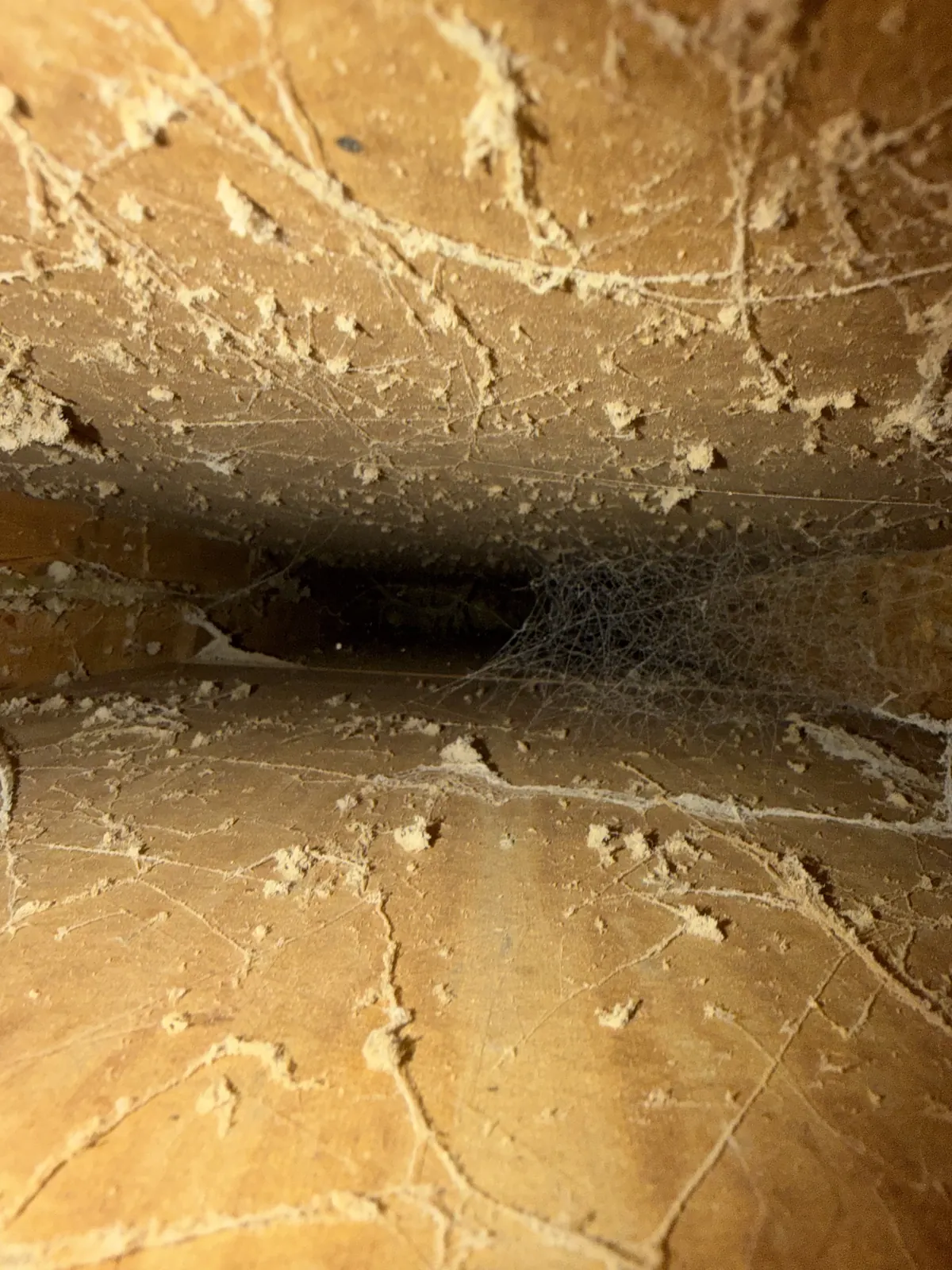
Houses built in Hillsborough, Montgomery and Branchburg from the 1980s through the 2000s often have a finished lower level, and the trunk line feeding the far end of the basement usually got boxed into a soffit or dropped behind a run of drywall rather than left exposed. That look holds up fine for years until a connection comes loose, a seam splits, or a branch duct pulls off a boot, and then the question becomes if the whole ceiling has to come down to reach it. Most of the time it does not.
What the soffit or drop ceiling is hiding
A soffit built around ductwork in one of these basements usually follows the trunk line from the mechanical room toward the far wall, sometimes dropping lower where a branch duct turns up into a stud bay to feed a register overhead. Behind that drywall or the soffit boards sits a run of sheet metal or flex duct, insulation where the trunk passes through unconditioned space, and the boots and takeoffs where branch runs leave the main trunk. None of that is visible once the finish work is done, which is exactly why a leak in one of these runs tends to show up somewhere else first, a weak register, a damp patch on the drywall, or a hiss audible only when the blower is running.
Reading the registers and the mechanical room first
Before anyone opens drywall, the first real information comes from outside it. Weak or no airflow at one register while its neighbors blow normally often points to a disconnected branch or a crushed section between the trunk and that register. A whistle or hiss near a ceiling seam, especially where the soffit changes direction, usually marks a split seam rather than a full disconnection, since air escaping under pressure makes more noise than air that has stopped moving altogether. In the mechanical room, where the trunk is still exposed before it disappears into the finished section, a technician checks the takeoffs feeding the problem register and follows the duct as far as it stays visible, narrowing down which side of the wall the break sits on before anything gets cut.
Finding the leak without opening drywall
A smoke pencil or a hand held at a suspect seam while the blower runs shows air moving where it should not, and that test works through an existing access panel as often as it works in open space. Houses with a mechanical room access panel already built into the soffit, common in Hillsborough and Montgomery builds from this era, let a technician reach several feet of trunk without cutting anything new. Where no panel exists, a look at the framing from the mechanical room side or from a nearby closet sometimes shows the soffit's actual depth and the shortest path to the suspect joint, which matters once the decision turns to cutting.
What gets sealed from the boot or an existing opening
A split seam, a loose screw collar, or a boot that has worked partway off its takeoff can often get resealed through an existing panel or a modest reach-in, using mastic or foil tape rated for duct work rather than cloth duct tape, which dries out and lets go within a short stretch of time in a warm plenum space. Air Duct Repair covers this kind of reconnection and resealing work, and on a lot of these basements that is the entire fix, since the failure point sits within reach of an access panel or a joint already partly exposed at the mechanical room end. A disconnected branch that has dropped more than an inch or two from its boot is harder to coax back into place blind, and that is usually where the conversation shifts toward a small cut.
When a small opening is the plain answer
Some failures sit far enough into a run, or deep enough behind a soffit with no nearby access, that reaching them without cutting anything is not a realistic claim. A technician who tells a homeowner in Branchburg or Montgomery that a full ceiling has to come down for a single disconnected boot is usually overstating it, but one who promises every repair happens through a six-inch hole sight unseen is not being straight either. The honest version is a look first, through whatever access already exists, followed by a specific recommendation: reseal through the panel, or cut a defined opening sized to the repair, patched afterward by whoever handles the drywall side. AMG's part stops at the duct repair and the opening needed to reach it, not the drywall patch itself.
What decides the cost of this kind of repair
What a repair above a finished basement ceiling costs depends on how far the failure sits from an existing access point, if the fix is a reseal or a full reconnection, how much of the trunk has to be reached to confirm nothing else nearby has let go, and if a new access panel gets added so the same spot stays reachable without cutting again later. A written estimate after that first look spells out what Air Duct Repair covers on that house, and if Air Duct Cleaning makes sense as a separate visit once the run is sealed back up, since a repaired seam still benefits from having the dust and debris already inside the trunk cleared out while it is open.