Somerset County's growth townships were built in a hurry. Census estimates put the median house in Hillsborough, Branchburg and Franklin in 1986 and in Montgomery in 1994, and Montgomery's population nearly doubled during the 1990s alone. Those houses are now at the age when the original furnace, the original air conditioner or both come out. The equipment gets all the attention during that decision: brands, efficiency ratings, quotes side by side. The ductwork gets almost none, because the installer will connect the new unit to whatever is already there, and that ductwork decides how well the new system actually heats and cools the house.
The U.S. Department of Energy's Building America guide to HVAC renovations puts it in one line: if you replace the equipment but keep the existing ducts, the ducts should be assessed for proper sizing, balanced pressures, airflow to each register and adequate return air to the furnace. In a Somerset County house from the boom years, that assessment comes down to four places: the returns, the joints, the attic runs and the dust the old system left behind.
Start with the return side
The same DOE guide names inadequate return airflow as one of the common problems with existing duct systems, and the houses of the 1980s and 1990s are a good example. Many were built with one or two large returns in a hallway or a stairwell and none in the bedrooms. Close the bedroom doors at night and the supply air has no easy way back, so the rooms pressurize, the hallway grille whistles, and the blower pulls harder on whatever gaps it can find, including the space around a loose filter. A new furnace or air handler with a stronger blower can make the whistle louder without making the room any more comfortable. Check the filter slot too: a rack that has lost its cover lets the new blower draw unfiltered basement air straight past the filter.
The fixes are ductwork, not equipment: a return added in the bedroom wing, or, as the DOE guide describes, jump ducts or transfer grilles that let air pass from a closed room back to the common space. Air duct installation handles that work, and it is far easier to do while the old equipment is out and the plenum is open than after the new unit has been boxed in.
Seal the joints the installer will not touch
An equipment swap usually ends at the plenum. The installer builds a transition from the new cabinet to the old trunk, seals that, and leaves. Everything downstream stays as it was: the takeoffs where branches leave the trunk, the elbows, the boots under each register, the flex connections in the attic. The DOE guide recommends mastic painted on all seams and joints, flex connections reinforced with approved metal tape and compression bands, and warns that cloth-backed duct tape can dry out and fail within months. Many houses from the boom years were taped rather than sealed. Air duct repair goes joint by joint and replaces tape with mastic where the joint can be reached.
The attic runs in two-story houses
A two-story house from these decades often heats and cools its second floor from a separate air handler in the attic, fed by insulated flex that has now been through decades of attic summers. Over that time the outer jacket cracks, the insulation settles, and runs that were pulled tight sag between the trusses or slip off their collars. Whichever bedroom sits farthest out, often the one over the garage, gets whatever air survives the trip. When the attic unit is replaced, those runs are worth walking one by one. Townhouses of the same era often hide that air handler above the upstairs hall, reached by a pull-down stair, and the same checks apply there. A disconnected collar is air duct repair, and a run that has collapsed or torn is replaced through air duct installation, ideally on a shorter and better supported path.
Clean before the new blower runs, or right after
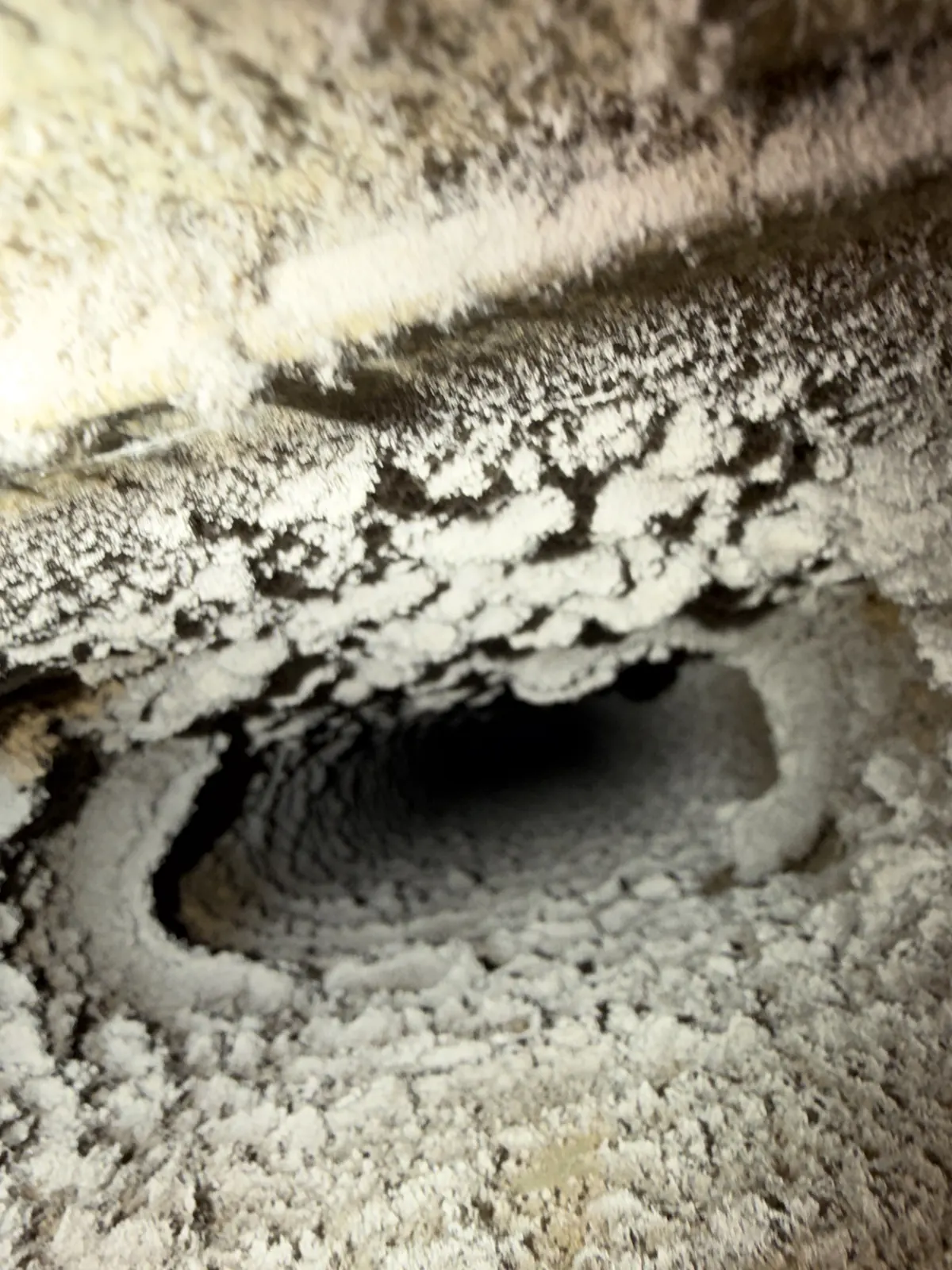
Decades of filters let dust through, and a boom-era house may still carry drywall dust and sawdust from construction in the trunk and the lowest boots. A new blower moves that material straight to a new coil. The practical order is to inspect first, repair or replace what needs it, and then run air duct cleaning either just before the new equipment is connected or right after, while the plenum is still open and the installation debris, sheet metal scraps and dust from the work are still easy to catch. Scheduling the cleaning around the swap costs far less disruption than opening the system again a year later.
The new air handler is also a convenient moment for HVAC UV light installation, with the lamp mounted to shine on the new coil. It can help keep that coil from growing anything between services, as one layer beside a good filter and a drain that works. If the old coil or pan already showed growth that spread into the plenum or the ducts, mold treatment and removal on those surfaces belongs before the new equipment is connected.
What to ask for on the estimate
Ask where the returns are and whether they are big enough for the new blower. Ask which joints will be sealed and with what. Ask whether the attic runs will be inspected, and whether any duct board plenum is torn or sagging. Ask whether the old ducts will be cleaned, and when. If the new furnace will vent through the wall instead of the chimney, ask what will still use the chimney, because a water heater left alone in a large flue may need chimney repair in the form of a liner sized to it. None of these questions is about the equipment, yet each one affects how the equipment performs.
Where this matters most
In Montgomery, where half the housing went up in the 1990s and 2000s, and in Hillsborough, Branchburg and Franklin, where the 1980s were the busiest decade, the replacement cycle is arriving house by house. The equipment will be new either way. Whether it runs against a leaky, undersized, dusty duct system or a sealed and cleaned one is the part the homeowner still controls, and the time to settle it is before the new unit is connected, with air duct repair first and cleaning close behind.
Sources
- U.S. Department of Energy, Building America Best Practices, Energy Renovations: HVAC
- U.S. Census Bureau, American Community Survey 2020 to 2024, median year structure built, Hillsborough, Branchburg, Franklin and Montgomery townships (Census Reporter)
- U.S. Census Bureau, American Community Survey 2020 to 2024, year structure built, Hillsborough, Branchburg, Franklin and Montgomery townships (Census Reporter)
- Wikipedia, Montgomery Township, New Jersey, with the U.S. Census Bureau counts for 1990 and 2000