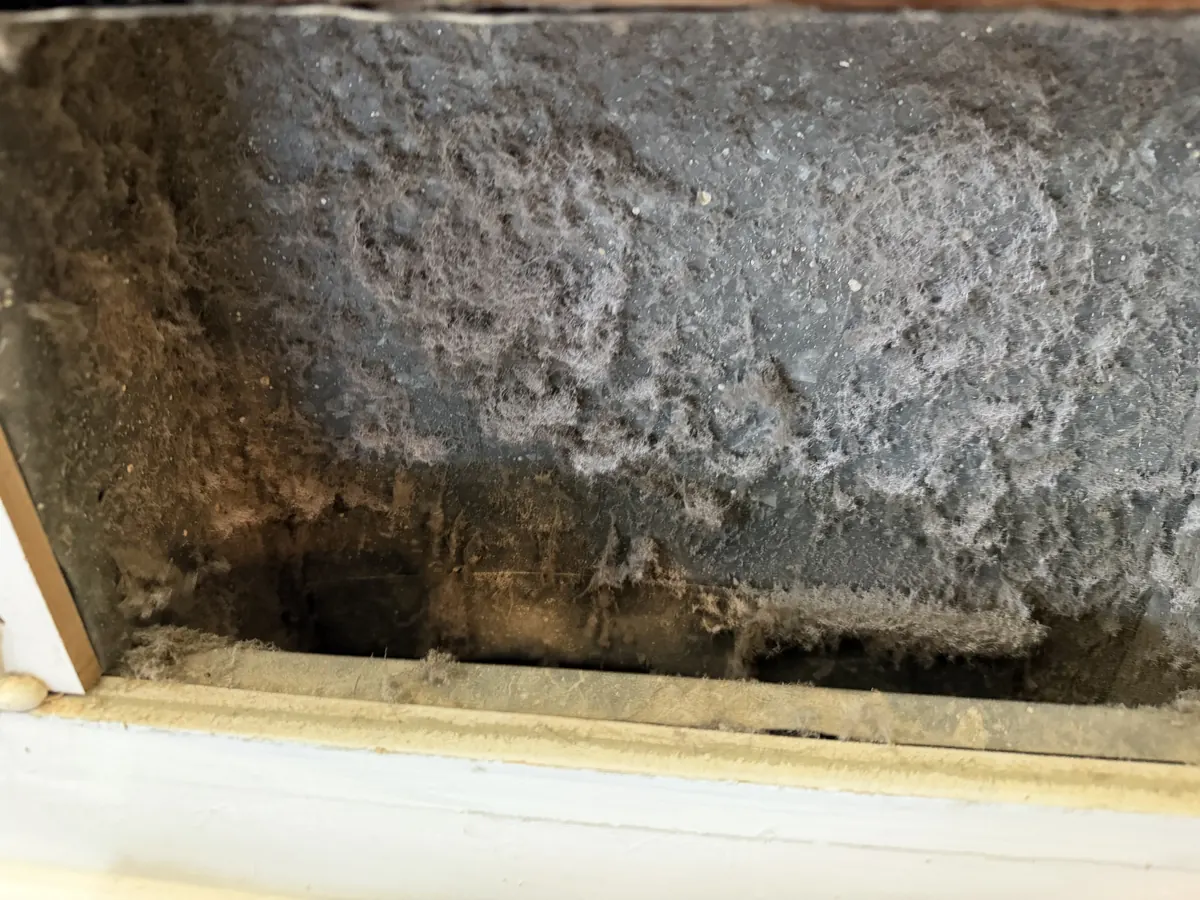
A unit that was framed, drywalled, and finished within the last year or two feels like it should be the cleanest air in town, and in most ways it is. But a duct system does not start clean just because the building is new. The trunk lines and branch runs get installed early in construction, often before drywall is hung, and they sit open to the job site for weeks while crews cut sheet metal, sand joint compound, and run cable through the same joist bays. Registers get capped with plastic or tape toward the end of the job, but that happens after a fair amount of dust has already settled inside the duct, not before.
Construction dust that outlives the move-in day
Drywall dust is fine and powdery, which means it rides the airstream rather than sitting still, and a system that has never been cleaned pushes a share of it through the registers every time the blower starts. Sheet metal shavings from duct fabrication, insulation fibers cut loose from flex runs, and sawdust from framing all end up in the same trunk line. The first few weeks a new HVAC system runs, including the test cycles a contractor runs during commissioning, are usually the dustiest the ductwork will ever push through the registers, because that is when all of this loose material gets stirred and carried toward the rooms. A building raised on a redevelopment parcel near the train tracks, where excavation and paving work went on next door for months, adds outdoor grit to the mix through open windows and fresh air intakes during construction.
Who controls the duct system in a rental
This is the part that trips tenants up. In an owner-occupied house, the person who lives there decides when the ducts get cleaned. In a rental, that decision usually belongs to whoever owns the mechanical equipment, which is almost never the tenant. A newer apartment building near the Somerville train station typically runs one air handler per unit, with ducts hidden above a dropped ceiling or inside a soffit, and that equipment is part of the building's capital stock even though it only serves one apartment. Property management or the building owner schedules service for it, the same way they schedule elevator inspections or boiler service for shared systems. A single-family or two-family rental in Raritan or a similar older house works differently, where the landlord who owns the whole building usually makes the call directly rather than through a management office.
How a tenant asks management for a cleaning
Start with the lease. Most leases spell out who is responsible for HVAC maintenance, and that clause usually points to management for anything beyond changing a filter. A written maintenance request works better than a phone call, because it creates a record and lets the tenant describe exactly what prompted it: dust visible on the supply register, a musty smell when the system first turns on after sitting idle, or a filter that looks packed with construction debris rather than normal household dust. Asking directly whether Air Duct Cleaning was done before the unit was leased is a fair question, since plenty of builders hand off a unit without ever running a brush through the trunk line. Management is more likely to act on a specific, documented request than a general comment that the air feels dusty.
What a tenant can check at the return and filter
A tenant does not need access to the whole system to learn something useful. The return grille is usually the easiest spot to check, since it is often built into a hallway wall or a closet door and does not require tools to open. A thick, gray coating of dust across the grille slats points to a filter that has not kept up, either because it was never changed after move-in or because it was sized wrong for the slot. Pulling the filter itself, where the slot is accessible without a screwdriver, shows the same thing from the other side: a filter that looks packed solid after only a short time in place is catching more construction dust than a normal household would produce on its own. A supply register that puts out noticeably less air than the one in the next room can mean a kink or a loose connection behind the ceiling, which is worth mentioning in the same maintenance request rather than treating it as a separate issue.
Where repair and UV light fit into a new building
New construction is not immune to installation mistakes. A plenum seam taped rather than mechanically fastened, a flex run strung too tight behind a dropped ceiling, or a branch duct that was never fully connected at the register box are all things that show up in buildings finished within the last few years. Air Duct Repair addresses a seam, a kink, or a disconnected run once it is found, and in a new building that is usually a contained fix rather than a full rebuild, since the duct material itself is sound. Some buildings add HVAC UV Light Installation to a shared air handling unit or to individual units as an extra layer against airborne growth on the coil, but a UV lamp works alongside filtration and moisture control, not in place of either one, and it does nothing about the loose construction dust already sitting in the duct runs themselves.
What decides the cost of a visit in a new building
What a cleaning or repair costs in a newer apartment building depends on how the ducts are routed, whether the unit shares a trunk line with neighboring apartments or runs its own dedicated system, how many registers and returns are involved, and whether the access panel sits in an easy spot or behind a finished ceiling that has to be opened carefully. A written estimate after a look at the unit's layout and register count lays out what the visit covers, which matters for a management office weighing one unit against a whole building's worth of the same work.