A short, straight vent on the first floor is a reasonable job for a careful homeowner. A long run through a floor or up to a roof is not. This guide covers the safe way to do the first kind, the mistakes that cause trouble, and the signs that the second kind is yours to hand over.
Decide first whether this is a job for you
Look at the route before you buy a brush. If the vent leaves through a wall within a few feet of the dryer and you can reach the cap from the ground, a home cleaning is realistic. If the vent runs through a floor, a ceiling or an attic, ends on a roof, or ends on a wall you can reach only by ladder, the lint is mostly in places you cannot see or safely reach. The same goes for a gas dryer you have never moved, and for any vent where the dryer has sat tight against the wall for years.
Start outdoors. A guide from the Pacific Northwest National Laboratory suggests confirming that the duct ends outside and not in an attic or crawl space, that the flap opens freely and that the cap has no screen. The Consumer Product Safety Commission says to watch the outside vent while the dryer runs and confirm that exhaust air is escaping. If no air comes out, the vent is blocked.
The steps, in order
First, disconnect the power. Pull the dryer out and unplug it before touching the duct, and both the PNNL guide and the GE Appliances cleaning steps call for it. If the dryer is gas, the manuals we checked call for closing the shutoff valve in the gas supply line as well, and some go on to disconnect and cap the line. Read your own manual, and do not disconnect a gas line unless you have done it before. If you smell gas at any point, leave the house and call the gas utility from outside.
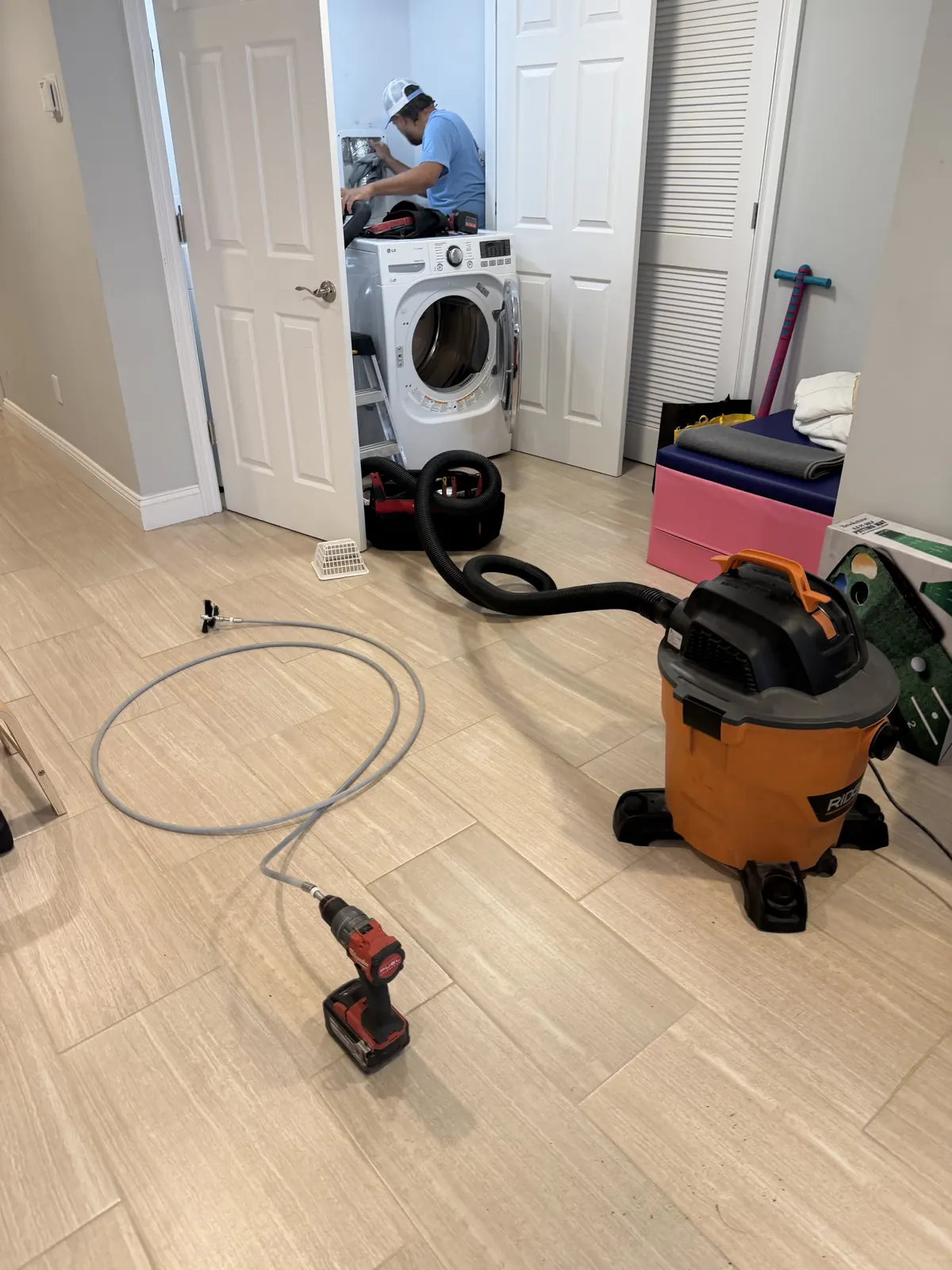
Second, loosen the clamp at the back of the dryer and take the duct off. Third, clear the lint. A vacuum with a hose attachment will pull it out of the end of the duct, and a dryer vent brush kit with flexible rods reaches further. PNNL's steps say to rotate the brush as you push, to vacuum the loosened lint and to repeat from the outdoor end if you can reach it. Pull lint out of the run and not toward the cap.
Fourth, clean behind and under the dryer, where lint collects, and clean the lint screen and its slot. The CPSC advises cleaning the screen before or after each load and keeping the area around the dryer free of clutter. Fifth, reconnect the duct with the clamp, push the dryer back without crushing the duct, plug it in, and open the gas valve again if it is a gas model. PNNL's guide warns not to crush the vent duct, and to keep it short and direct, with no loops.
The mistakes that cause trouble
Do not run the dryer with the duct off, since the lint and hot air go into the room. Do not push lint toward the cap with a leaf blower or a stiff brush in a run with elbows. It can pack lint into a bend, and if the cap is blocked the lint has nowhere to go. We prefer pulling the lint out with a vacuum.
Do not reuse plastic or foil accordion duct. The CPSC advises replacing it with rigid or corrugated semi-rigid metal, because the flexible kind traps lint and is easy to kink or crush. Do not tape the connection or leave the clamp loose, and do not put a screen over the cap. Do not use tools on a vent you cannot see into, because a brush can catch on a joint and pull a section apart inside a wall.
Run it, then check it
When the duct is back on, run the dryer and go outside. The flap should open and stay open while the dryer runs, and you should feel warm air at the cap. The National Fire Protection Association says to clean lint out of the vent pipe once a year, or more often if clothes are taking longer than normal to dry, and it names failure to clean as the leading cause of home dryer fires. The U.S. Fire Administration puts the figure at 31 percent for home clothes dryer fires from 2018 to 2020.
When to book a cleaner instead
Book a cleaner when the vent goes through a floor, ceiling or attic, when it ends on a roof or an upper wall, when the dryer is still slow after you cleaned the run, when you find foil duct or a crushed section behind a finished wall, or when you smell something scorched. If you rent, the building's duct and cap are usually the landlord's, so the call goes through them. A cleaner can brush the full run, check the cap and tell you whether the route itself is the problem.
If the route is the problem, a run that is too long, has too many turns or ends in the wrong place, dryer vent installation is the repair, and dryer vent cleaning is the maintenance after it.
Sources
- Pacific Northwest National Laboratory, Building America, Clean Dryer Exhaust
- GE Appliances, Dryer: How to Clean Exhaust / Vent Duct
- U.S. Consumer Product Safety Commission, Overheated Clothes Dryers Can Cause Fires (Publication 5022)
- National Fire Protection Association, Clothes Dryer Safety Tips
- U.S. Fire Administration, Appliance and Electrical Fire Safety