Commercial air distribution projects in Somerville, New Jersey succeed when engineering, permitting, and installation stay synchronized from the first sketch to the final inspection. Office suites, retail storefronts, restaurants, health facilities, and light industrial spaces all depend on reliable airflow to deliver comfort, protect indoor air quality, and support code-required ventilation. This guide explains how to align design intent with the local permitting process, outline responsibilities among stakeholders, and check the details that matter most on inspection day. If you want a partner who can translate plan sets and specifications into a clean, code-aligned build, consider collaborating with a local team specializing in air duct installation for commercial spaces.
Permits are not paperwork for its own sake; they organize accountability and safety. A permit set documents how the system will meet mechanical, building, energy, and fire code requirements. It establishes expectations for duct construction, insulation, support, fire and smoke protection, outdoor air delivery, and equipment access. When your design anticipates inspector focus, you reduce back-and-forth and help your tenant improvement or new build open on schedule.
Establish scope and code pathways
Start by clarifying occupancy type and use. A restaurant kitchen will prompt different ventilation and separation requirements than a quiet office suite or a health services space with stricter filtration and pressure relationships. Identify which code editions and local amendments apply in Somerville, and verify whether the project is a fit-out of a shell space, a change of use, or a complete new construction. These distinctions shape submittal requirements and inspection sequencing.
Define performance goals alongside code minimums. Comfort setpoints, noise criteria, and maintenance access inform duct sizes, velocities, and fitting choices beyond what the code strictly requires. When design teams state these goals up front, the duct layout often becomes simpler, quieter, and easier to service.
Develop drawings and calculations
Complete mechanical plans that include supply and return duct routing, sizes, cfm by diffuser, outdoor air quantities, fire/smoke damper locations, balancing dampers, and equipment schedules. Provide details for plenum construction, hanger spacing, penetration firestopping, and insulation thickness in unconditioned areas. Support the plans with load calculations, ventilation rate calculations, and fan curves that demonstrate adequate airflow at the design static pressure.
When exhaust systems are involved—such as for restrooms or kitchens—coordinate with make-up air and pressure control so the building remains balanced. In mixed-use buildings, verify that penetrations through rated assemblies are addressed with appropriate dampers or firestop systems.
Coordinate with other trades
Duct layouts compete with structural elements, electrical conduit, plumbing, and fire sprinklers for ceiling space. Early coordination avoids conflicts that would otherwise require field changes, extra fittings, or compressed ducts that elevate noise and reduce airflow. Reserve maintenance access around air handling units, filters, coils, and fire/smoke dampers; inspectors often verify that service clearances match the manufacturer’s instructions.
Acoustics deserve early attention as well. If a tenant requires low background noise, choose velocities and fittings that reduce turbulence, and consider lined return ducts. Placing loud components or high-velocity sections away from conference rooms or treatment areas helps you deliver a quiet environment without costly after-the-fact fixes.
Permit application and submittals
Prepare a complete submittal package. Include stamped mechanical drawings as required, load and ventilation calculations, equipment data sheets, damper schedules, and insulation specifications. Some projects require separate fire protection or electrical submittals that reference mechanical details like interlocks for smoke control or kitchen hood systems. Clearly label details like access doors for dampers and cleanouts, because inspectors and maintenance staff rely on these for future service.
Many jurisdictions prefer digital submissions, but confirm current Somerville procedures and timelines. A well-organized package with legible plans and clearly indexed documents speeds plan review and reduces requests for information.
Preconstruction meeting and sequencing
Before fabrication, host a coordination meeting with the GC, mechanical contractor, and key trades. Review routing, hanger strategies, penetrations through rated assemblies, and milestones that trigger inspections. Establish rules for material storage to protect duct interiors from debris, and plan for temporary caps that keep dirt out before startup. Agree on how changes will be documented to keep the permit set aligned with field conditions.
Sequencing matters. Installing major trunk lines before lighting or ceiling grids often prevents conflicts and rework. If you are replacing ducts in an occupied space, plan phasing and temporary conditioning so the business can continue operating safely.
Fabrication and installation standards
Commercial ducts should meet recognized construction standards for thickness, seams, joints, and reinforcement. Hangers and supports must follow spacing guidelines and avoid compressing insulation. At each connection, seal joints with mastic or approved tapes to achieve airtightness compatible with performance goals and energy code expectations. Where ducts pass through unconditioned zones, insulate to specified R-values and protect vapor barriers to prevent condensation.
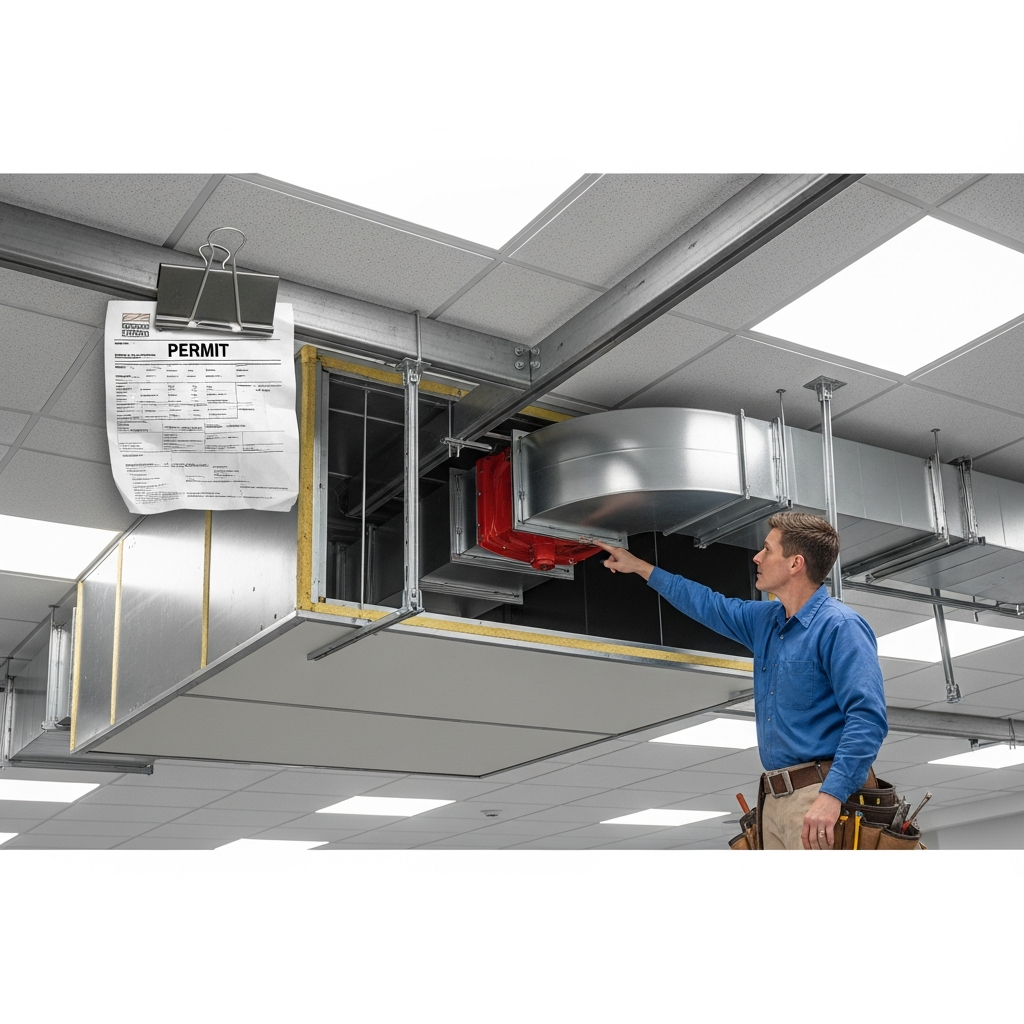
Fire and smoke protection is central to commercial work. Install fire/smoke dampers exactly as specified, with proper sleeves, breakaway connections, and access doors for inspection and service. Identify each damper location on the field drawings and label access panels clearly. Penetrations through rated assemblies must be firestopped with listed systems that match the assembly type.
Outdoor air and ventilation verification
Ventilation codes prescribe minimum outdoor air rates based on occupancy and floor area. Provide dedicated outdoor air ducting, controls, and balancing dampers to deliver the calculated quantities. During commissioning, verify that outdoor air is flowing under typical operating conditions and that economizer or demand-control ventilation operates as intended. Carefully sealing and insulating outdoor air runs reduces condensation risks and protects indoor air quality.
Exhaust systems must be balanced with supplies to avoid negative pressure that can draw in unconditioned or contaminated air. Coordinate toilet exhaust, kitchen exhaust, and any process exhaust with make-up air supply and control logic.
Field changes and documentation control
Changes in the field happen. Maintain a redlined set of drawings that capture modifications to routing, sizes, or damper locations. If changes are significant, submit revisions for approval so the permitted documents match the installation. Inspectors often compare field conditions to the permitted plans; alignment reduces surprises and re-inspection delays.
Document test results as the project advances. Leakage testing, pressure readings, and preliminary balancing data help prove compliance and guide fine-tuning before final inspection. Keep equipment submittals, damper data, and O&M manuals organized for turnover.
Testing, balancing, and commissioning
Commercial systems should be tested and balanced by qualified personnel. Verify fan speeds, static pressures, and airflow at representative diffusers. Adjust balancing dampers to meet design flows within acceptable tolerances. Confirm that fire/smoke dampers cycle as required and that controls deliver the intended ventilation and comfort sequences. Temperature and humidity checks during typical occupancy validate that the system performs beyond the numbers on a plan sheet.
Midway through construction, it can be strategically valuable to bring in a Somerville-focused team experienced in air duct installation to review workmanship, sealing quality, damper access, and documentation. Early feedback reduces punch lists and saves time as you approach substantial completion.
Inspection preparation and closeout
Before calling for inspection, perform an internal audit. Confirm that dampers are labeled, access doors are installed and reachable, penetrations are properly firestopped, and supports meet spacing and type requirements. Clean interior ducts of construction debris and remove protective caps. Ensure that outdoor air intakes are clear of contamination sources and that final balancing reports are available.
At closeout, provide O&M materials, as-built drawings, damper schedules, and testing reports. Walk maintenance staff through access points, filter changes, and controls that affect ventilation rates or pressurization. Good turnover reduces callbacks and supports healthy, comfortable occupancy.
FAQ
Q: Do all commercial duct projects in Somerville require permits? A: Most alterations and new installations do. The specific path depends on scope and occupancy, so verify with local authorities and your design professional.
Q: What do inspectors focus on? A: Common focal points include duct sealing and insulation, fire/smoke damper installation and access, penetrations through rated assemblies, support methods, outdoor air verification, and documentation that matches the permitted plans.
Q: How early should balancing be considered? A: From the design stage. Providing balancing dampers and access, reasonable velocities, and straight runs to diffusers makes final balancing faster and more accurate.
Q: How can I minimize change orders? A: Early coordination with other trades, clear shop drawings, and timely RFIs reduce late-field adjustments and preserve the design’s performance intent.
Q: What helps keep noise low in commercial spaces? A: Appropriate duct velocities, long-radius fittings, lined returns where appropriate, and thoughtful diffuser selection near sensitive areas like conference rooms or clinics.
Set your project up for success
From plan review to punch list, the most successful commercial projects connect design, documentation, and field execution. If your Somerville build or renovation is ready for a coordinated, inspection-ready approach, work with a local contractor skilled in commercial air duct installation who can navigate codes, protect schedules, and deliver quiet, reliable airflow for occupants.
