
Introduction
Installing new ductwork is one of the most transformative upgrades you can make to a home’s heating and cooling system, especially in a four-season community like Somerville, New Jersey. Whether you are retrofitting an older house or planning a renovation, understanding the correct sequence, materials, and best practices will help you achieve reliable comfort, clean indoor air, and efficient energy use. In this comprehensive how-to guide, we walk through the full process from preparation and layout to sealing, insulating, and commissioning the ducts. If at any point you decide that a seasoned expert would make the project smoother, consider professional air duct installation to ensure everything is designed and installed to current standards.
Somerville’s climate places real demands on duct systems: hot, humid summers followed by cold winters require balanced airflow, airtight connections, and proper insulation to keep rooms comfortable and utilities manageable. The right installation approach accounts for these local realities, ensuring that conditioned air reaches every room with minimal losses and noise.
Understand Your Home and Project Scope
Before ordering materials or cutting openings, define the project scope. Are you adding ducts to rooms that never had supply or return registers? Are you replacing underperforming ducts in an attic or crawlspace? Are you tying into an existing furnace or heat pump, or upgrading the air handler at the same time? The answers shape the duct size, materials, and the number of supply and return runs you will need.
Equally important is an understanding of the home’s construction. Many Somerville homes feature basements that can serve as mechanical spaces, with runs to the first and second floors. Others rely on attic pathways or sealed crawlspaces. Each location has implications for condensation control, insulation R-values, and support strategies.
Safety, Codes, and Permits
Ductwork serves a critical role in life safety and home health. Consult your local building department about permitting requirements and inspection timing. Typical rules cover support spacing, clearances from combustible materials, sealing standards, and insulation in unconditioned spaces. If combustion appliances are present, ensure you maintain required clearances and preserve adequate makeup air to prevent backdrafting. Always turn off power to equipment before working around the air handler, and use protective gear when cutting sheet metal or insulation.
While this guide offers broad best practices, local code is the final authority. Plan for rough-in and final inspections where applicable, and keep documentation of materials (such as UL 181-rated tapes and mastics) readily available for review.
Tools and Materials Checklist
Gather tools and materials in advance so the installation proceeds efficiently. The list below covers common needs for a full-home installation.
- Measuring tape, laser measure, and level
- Sheet metal snips, utility knife, and aviation snips
- Screw gun or drill with sheet-metal bits
- Duct board knife for fiberglass duct board (if using)
- Crimpers and benders for metal duct fittings
- Foil-faced insulation, duct wrap, or pre-insulated flex where appropriate
- UL 181-rated foil tape and duct mastic
- Metal screws (self-tapping), S-cleats, drive cleats
- Hangers, strapping, and support brackets
- Fire-rated sealants where required for fire-rated assemblies
- Dampers, takeoffs, starting collars, wyes, elbows, and boots
- Register grilles and balancing dampers
- Smoke detector and CO detector for safety near mechanical spaces
Planning and Sizing the System
Good installation starts with good design. At minimum, create a scaled layout that identifies trunk lines, branch runs, supply registers, and return locations. Note ceiling heights, joist directions, and obstructions such as beams or plumbing. For comfort and noise control, place supply registers to throw air across rooms and returns in central, unobstructed spots. In bedrooms, a door undercut alone is often insufficient for return airflow; consider dedicated return pathways or jumper ducts to equalize pressure.
Duct sizing deserves extra care. Undersized ducts lead to whistling registers, temperature imbalances, and equipment strain; oversized ducts may reduce velocity and mixing. Use established sizing methods to estimate required airflow (CFM) for each room, then select trunk and branch sizes that deliver those flows with acceptable static pressures. Keep equivalent lengths in mind: multiple elbows and flex runs add resistance. Where possible, smooth, short runs with gentle fittings outperform long, crimped, or kinked pathways.
Choosing Duct Materials
You can install duct systems with sheet metal, fiberglass duct board, or flexible ducts—often a combination. In attics and crawlspaces, insulated flex can be effective for branches if installed taut, well-supported, and sealed. Trunks and plenums are typically rigid metal or duct board for durability and static pressure control. Whichever material you pick, the principles remain the same: airtight connections, adequate insulation, proper support spacing, and thoughtful routing to minimize restrictions.
Site Preparation and Layout
Mark register locations on floors, walls, or ceilings as appropriate. Confirm furniture layouts so supply throws are not blocked by tall shelving or draperies. In the mechanical space, verify that the air handler and plenum locations allow smooth transitions into the main trunk lines without tight bends. Pre-cut boots and register openings carefully, and frame as needed to maintain structural integrity.
Use chalk lines to mark trunk routes across joists or along attic pathways. In basements with open ceilings, plan for adequate headroom and protect ducts from accidental impacts. Where crossing structural members is unavoidable, consult a qualified professional to avoid compromising framing.
Step-by-Step Installation Procedure
- Set the Air Handler and Plenum: Install the furnace, air handler, or coil cabinet per manufacturer instructions. Attach a properly sized supply plenum and return plenum with sealed, mechanically fastened connections.
- Install Main Trunks: Run the supply and return trunks first. Keep them straight, level, and well-supported. Use long-radius elbows where space permits and avoid sudden transitions. Mechanically fasten all joints and seal seams with mastic or UL 181 foil tape, then mastic over the tape.
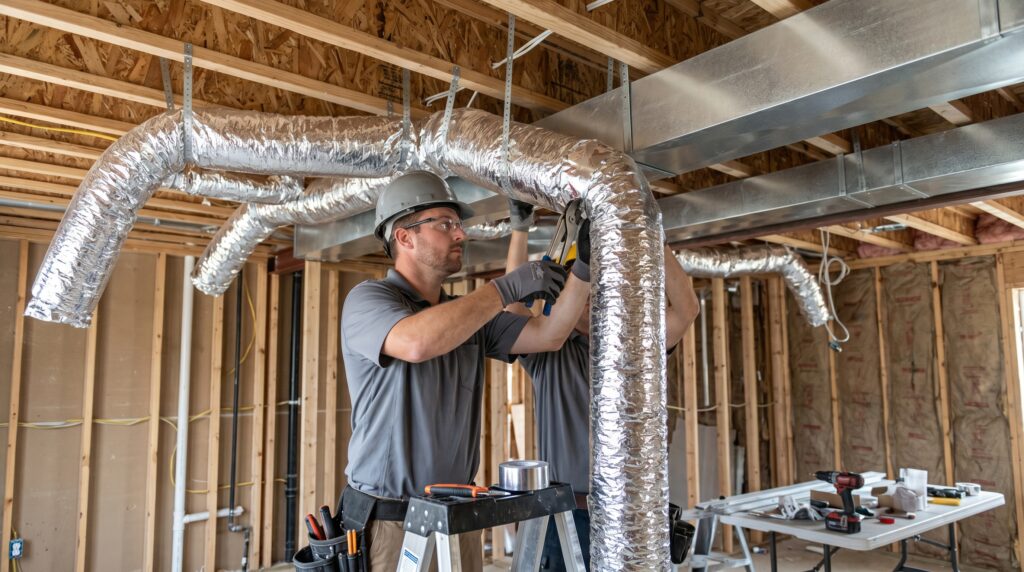
- Add Takeoffs and Branches: From the main trunks, install takeoffs to each room’s branch run. Crimp and bead connections as needed, secure with screws, seal with mastic, and insulate. For flex branches, pull the inner liner tight, secure to the collar with a drawband and mastic, then smooth the outer jacket and insulation over the connection.
- Place Boots and Registers: Fit floor, wall, or ceiling boots at the predetermined locations. Secure to framing, seal any gaps around boots with foam or sealant rated for the assembly, and cap the openings to keep debris out during construction.
- Support and Strap: Support rigid duct at code-compliant intervals, typically with metal hangers or strapping. For flex, use wide supports to avoid compression; keep runs as straight and short as possible. Avoid sagging and sharp bends that reduce airflow.
- Seal Every Joint: Air leaks cost comfort and efficiency. Brush on mastic at seams, around collars, and over screw penetrations. For duct board, use approved fiberglass tape with mastic for long-term performance.
- Insulate in Unconditioned Spaces: Wrap trunks and branches located in attics, garages, or crawlspaces with insulation of adequate R-value to prevent condensation and thermal losses. Seal all vapor barriers to prevent moisture intrusions.
- Install Balancing Dampers: Add manual dampers on branch lines near the trunk to fine-tune airflow to each space. Label damper handles for future adjustments.
- Pressure Test and Inspect: Before closing ceilings or finishing chases, test for leaks, confirm supports, and check clearances around flues, electrical, and plumbing. Correct issues now to avoid rework later.
- Register Installation and Finish: Once finishes are complete, install supply and return grilles. Confirm that the blades direct airflow where intended and that filters are correctly sized at the return.
Mid-Project Checks and Adjustments
As the installation progresses, pause to verify assumptions. Are any rooms far from the air handler under-supplied based on equivalent length and fittings? Would a slightly larger branch or an additional return improve circulation? Are you maintaining service access at the air handler and ensuring filter changes will be convenient? Mid-course corrections are far easier before surfaces are closed. If you encounter unexpected obstacles or you want assurance that performance targets will be met, you can engage professional air duct installation support to validate sizing and workmanship.
Noise Control Strategies
Quiet operation is a hallmark of a quality duct system. Keep supply velocities reasonable and avoid abrupt transitions at the plenum. Use lined trunks or short lengths of acoustical duct near the air handler to reduce blower noise. Isolate metal ducts from framing with vibration-dampening hangers where feasible, and separate returns from bedrooms or studies if sound sensitivity is a concern.
Managing Condensation and Moisture
Somerville’s summer humidity underscores the importance of proper insulation and vapor barriers. Cold supply ducts running through hot, damp attics will sweat if insulation is inadequate or compromised. Repair any tears in the jacket, seal seams, and maintain continuous vapor barriers. In crawlspaces, ensure grounds are properly covered and vents or conditioning strategies limit moisture, reducing the chance of microbial growth.
Fire and Smoke Considerations
Where ducts pass through fire-rated assemblies, use approved firestopping methods. Return chases must be constructed with materials that meet code requirements, and open wall cavities should not be used as return plenums unless allowed and properly lined. In multi-level homes, confirm that penetrations do not compromise required fire separations. In some cases, fire dampers or smoke detectors within the duct system may be mandated by code or manufacturer instructions.
Air Balancing and Commissioning
Once the physical installation is complete, the goal is to deliver the right amount of air to each room. Start the system and measure airflow at each register using an anemometer or balancing hood if available. Adjust branch dampers to match design targets, and confirm temperature splits across the coil match manufacturer expectations. Evaluate static pressure at the supply and return plenums; high static can indicate restrictions, dirty filters, or undersized ducts.
Document damper positions, register settings, and filter sizes. Provide a map of the duct system for future service, noting hidden junctions and access panels. This recordkeeping will save time and avoid guesswork during maintenance or upgrades.
Common Mistakes to Avoid
- Overusing flex duct and allowing it to sag, kink, or compress around tight turns
- Ignoring return pathways and relying solely on door undercuts in closed-door rooms
- Skipping mastic sealing and depending only on tape for long-term airtightness
- Placing supply registers behind large furniture or curtains, which disrupts air throw
- Failing to insulate ducts in unconditioned spaces, causing sweating and energy loss
- Neglecting balancing dampers, leaving some rooms too warm or too cool
- Routing ducts too close to combustion appliances, violating clearance requirements
Maintenance After Installation
Even the best installation needs routine attention. Replace or clean filters on schedule, keep supply and return grilles free of dust and obstructions, and inspect exposed duct sections annually for insulation damage, pests, or moisture. In basements, verify that supports remain tight and that accidental impacts have not dented or loosened connections. In attics, look for signs of condensation or animal activity and repair jackets promptly.
If the system seems louder than expected or rooms drift out of balance across seasons, revisit damper positions, confirm that doors and returns are unobstructed, and ensure the equipment is operating properly. Periodic professional tune-ups can catch small issues before they become comfort problems.
Frequently Asked Questions
Q: How many returns does my house need? A: Most homes are more comfortable and consistent with multiple returns, especially on each level. The goal is to provide low-resistance pathways back to the air handler so closed doors do not starve rooms of airflow.
Q: Is flex duct acceptable? A: Yes, when installed correctly—kept short, taut, well-supported, and sealed at both ends. Avoid sharp bends or compression that increase resistance. Use rigid trunks for best control of static pressure.
Q: What R-value should duct insulation be? A: In unconditioned spaces like attics or crawlspaces, higher R-values help minimize both heat loss and condensation. Follow local requirements and align with your climate zone for best results.
Q: Can I use wall cavities as returns? A: Only if permitted and properly lined and sealed. Many codes restrict this practice. Dedicated return ducting offers better performance and cleanliness.
Q: Do I need to pressure test the system? A: Pressure testing verifies leakage rates and can be required during inspections. Even when not mandated, it is a smart way to confirm sealing quality and long-term efficiency.
Q: What if some rooms still feel uneven? A: Re-check damper positions, verify register direction, and confirm no furniture blocks supply throws. Consider adding a return pathway or resizing a branch if airflow is persistently low.
Q: How often should ducts be inspected? A: Give exposed ducts a quick visual check each season and a more thorough inspection annually. Look for loose supports, damaged insulation, and signs of moisture.
Ready to Improve Indoor Comfort in Somerville?
If you want confidence that sizing, sealing, and balancing are all dialed in, schedule professional help to design and execute the project. Reliable workmanship ensures quiet operation, better indoor air quality, and year-round comfort. Connect with trusted local experts for seamless air duct installation and enjoy a system that performs the way it should.
PREVIOUS: Air Duct Installation Inspection Requirements In Somerville New Jersey
NEXT: Air Duct Installation Guide For Beginners In Somerville New Jersey
