
Setting the Standard: Air Duct Installation Requirements in Somerville
Understanding the requirements for air duct installation is essential for a safe, comfortable, and code-compliant home in Somerville, New Jersey. Beyond simply moving air, your ducts must meet performance targets, pass inspections, and stand up to the region’s humid summers and cold winters. This guide explains the major requirements—codes, sizing, sealing, insulation, materials, and verification—so you can plan your project with confidence. If you want local insight from the outset, consider consulting specialists in air duct installation who work with Somerville homes daily and understand how state and municipal rules apply on real-world job sites.
While each house is unique, the underlying principles do not change: correct airflow, airtight construction, appropriate insulation, and safe routing. Meeting these benchmarks not only satisfies inspectors but also ensures quieter operation, better indoor air quality, and long-term system reliability.
Permits, Codes, and Inspections
Somerville adheres to the New Jersey Uniform Construction Code and associated mechanical standards. Most duct installations require permits and inspections that evaluate firestopping, clearances to combustibles, return-air restrictions, support spacing, and accessibility for service. Your contractor should provide drawings or a clear description of the proposed layout so the inspector can confirm compliance at rough-in and final stages.
Key code-related requirements commonly reviewed include:
- Prohibited return-air locations such as closets housing fuel-fired appliances, garages, or areas that could introduce contaminants.
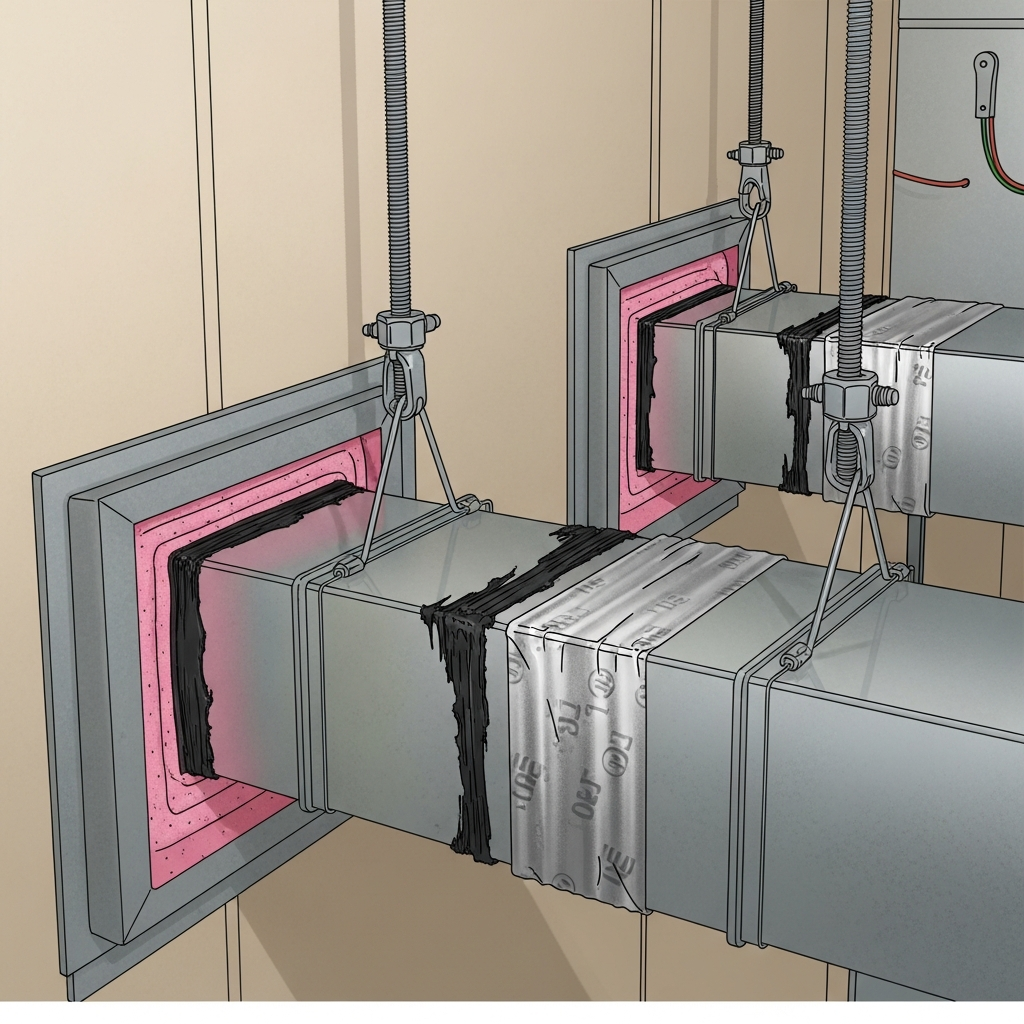
- Fire and smoke barriers: penetrations must be sealed with approved materials and methods.
- Clearances: ducts must maintain required distances from vent pipes, chimneys, and electrical equipment.
- Support and hanging: spacing and hardware must meet manufacturer and code specifications.
- Access: air handlers, filters, and dampers must remain serviceable after finishes are installed.
Airflow and Sizing Requirements
Correct sizing starts with a load calculation (Manual J or similar) to estimate each room’s heating and cooling needs. Those results convert to airflow targets (CFM) that your ducts must deliver. Duct sizing (Manual D or equivalent) then balances friction, velocity, and noise to achieve target CFM while keeping total external static pressure within equipment limits.
Practical requirements for sizing include:
- Trunk and branch dimensions must support cumulative airflow without exceeding recommended velocities that create noise.
- Return paths should be as generous as supply paths to avoid starving the system.
- Transitions should be smooth, with long-radius fittings where possible to reduce turbulence.
- Short runs of quality flex duct may be acceptable, but long, sagging, or compressed flex increases resistance and violates performance expectations.
Sealing Requirements
Air leakage undermines comfort and wastes energy. Requirements typically mandate that all seams, joints, takeoffs, and boots be sealed with mastic or UL-listed foil tape designed for duct applications. Return ducts must be sealed as diligently as supply ducts to prevent drawing dust, humidity, or fumes from unconditioned spaces.
In practice, this means:
- Brush-on mastic on longitudinal seams, slip joints, and collars.
- Foil tape rated for ductwork on clean, oil-free surfaces—no cloth duct tape.
- Sealed boots where they meet floors, walls, or ceilings to stop leakage into cavities.
- Documented leakage testing where specified, or verification during commissioning.
Insulation and Condensation Control
Insulation levels depend on duct location. In unconditioned attics, basements, or garages, higher R-values help prevent heat loss in winter and condensation in summer. Vapor barriers must face the correct direction to reduce moisture migration. Even in conditioned chases, a thermal layer can stabilize temperatures and dampen noise.
- Wrap ducts uniformly; avoid gaps, tears, or compressed insulation that reduce effectiveness.
- Tape or seal insulation seams to maintain a continuous barrier.
- Pay special attention near the air handler and long attic runs exposed to heat.
Material Requirements
Galvanized sheet metal is the standard for trunks and main branches due to its strength and smooth interior surface. Flex duct, when used, should be limited to short, straight runs and installed taut with proper support spacing. In select locations, fiberglass-lined metal may be used for sound attenuation, following manufacturer guidelines to preserve air quality and cleanliness.
Hardware requirements include appropriate hangers, vibration isolation where specified, and corrosion-resistant fasteners as needed for basements or areas with higher humidity.
Return Air Rules and Best Practices
Balanced return air ensures even temperatures and stable pressure. Many homes perform better with multiple returns or a central return system sized to handle the total airflow quietly. Code restricts returns from certain spaces, and returns should be located to promote complete room circulation without drawing from contaminated areas.
- Use return grilles sized to keep velocities low and noise minimal.
- Place returns on each level in multi-story homes for pressure balance.
- Seal return pathways thoroughly to avoid pulling air from wall cavities or attics.
Static Pressure and Commissioning Requirements
Static pressure must remain within your equipment’s rated range. During commissioning, technicians measure total external static pressure at the air handler, then verify room-by-room airflow with flow hoods or anemometers. Adjustments are made using branch dampers and register settings to hit the design targets established by your load calculation.
Commissioning documentation should include measured static pressure, final CFM readings, and damper positions. This record supports future troubleshooting and proves the system meets performance requirements.
Zoning Considerations
While not mandatory for every home, zoning can be a requirement for comfort in large or multi-level layouts. Motorized dampers, separate thermostats, and a well-designed bypass or static pressure strategy help each zone operate within manufacturer limits.
When zoning is included, requirements extend to damper accessibility, control wiring, and clear labeling so technicians can safely service the system.
Health, Safety, and Indoor Air Quality
Beyond code, responsible installations account for air quality. Airtight ducts help filters capture particulates, and correct return placement avoids drawing contaminants from undesired spaces. If your home includes combustion appliances, pressure balance and adequate return sizing reduce the chance of back-drafting and maintain safe operation.
Documentation and Homeowner Orientation
Upon completion, you should receive documentation: load calculations, as-built duct layouts, equipment manuals, and commissioning results. A brief homeowner orientation explains filter changes, register adjustments, and signs that indicate the need for service or rebalancing—especially after renovations that alter the load profile.
Applying Requirements to Somerville’s Housing Mix
Somerville offers a blend of historic homes, mid-century properties, and newer construction. In older homes, requirements often revolve around careful routing and firestopping where new chases are introduced. In newer homes, performance requirements may focus on improved return sizing, attic insulation levels on long runs, or adding zoning for additions built over garages or sun-exposed spaces.
Regardless of age, the principles remain: match airflow to room needs, seal meticulously, insulate appropriately, and verify performance. Meeting these requirements turns a new duct system into a lasting comfort upgrade.
Frequently Asked Questions
Q: Do I always need a permit for duct installation in Somerville?
A: Most projects do require a mechanical permit and inspections. Your contractor will determine the exact requirements based on scope and coordinate with the local authority.
Q: Is flex duct allowed?
A: Yes, when installed correctly and typically for short, straight runs. It must be supported, pulled taut, and not compressed or kinked. Long or winding flex runs increase resistance and are discouraged.
Q: How is duct leakage addressed?
A: All seams and joints should be sealed with mastic or UL-listed foil tape. Leakage testing may be specified; even when not required, commissioning measurements verify airtightness and performance.
Q: What insulation level is required?
A: Insulation R-values depend on duct location. Unconditioned spaces typically require higher R-values to manage heat transfer and condensation risk; your contractor will match local requirements.
Q: Are returns required on each floor?
A: While not a universal rule, multi-level homes often perform better with returns on each level to maintain pressure balance and even temperatures.
Q: How do I know ducts are sized correctly?
A: Documentation from load and duct calculations combined with commissioning data—static pressure and room CFM—demonstrates proper sizing.
Q: Will meeting these requirements reduce noise?
A: Yes. Correct sizing, smooth fittings, and balanced airflow significantly reduce whistling and rumble, leading to a quieter system.
Q: What if my home has limited space for ducts?
A: Designers can use compact round ducts, careful routing through soffits and closets, and limited, well-installed flex sections to meet requirements without compromising performance.
Move Forward with Confidence
When you understand the requirements—permits, sizing, sealing, insulation, and commissioning—you can make informed decisions and set clear expectations with your contractor. For guidance tailored to Somerville’s codes, climate, and housing styles, connect with trusted professionals who specialize in air duct installation services and ensure your project meets every benchmark for safety, comfort, and long-term reliability.
