In commercial and light-industrial buildings across Somerville, New Jersey, ductwork forms the backbone of indoor environmental control. When ducts are well sealed, insulated, and balanced, tenants enjoy consistent comfort, facilities teams field fewer hot/cold complaints, and equipment operates within its design envelope. Conversely, leaky or damaged ducts raise static pressure, waste energy, stir up dust, and compromise indoor air quality—issues that affect productivity and occupant confidence. This checklist gives facility managers, building engineers, and business owners a practical roadmap to plan, execute, and verify air duct repairs with minimal disruption to operations.
While many tasks can be completed by in-house maintenance staff, some require specialized instruments or safe access to rooftops and shafts. As you organize repairs, coordinate with tenants, schedule downtime around production cycles, and document each step for future audits. If scope expands beyond your team’s capacity, consider partnering with a local specialist in air duct repair who can provide testing, balancing, and code-aware remediation tailored to New Jersey commercial buildings.
Somerville’s mixed building stock—historic main-street storefronts, mid-century offices, and newer multi-tenant suites—presents a range of duct configurations. Rooftop package units may feed multiple zones with complex branch networks, while older structures might combine sheet metal trunks with lengths of flexible duct added during fit-outs. A checklist-based approach ensures nothing is missed, regardless of building age or system type.
Planning and Pre-Assessment
- Define Objectives: Reduce hot/cold calls, improve IAQ, meet ventilation targets, and address code findings.
- Collect Documentation: Gather as-builts, mechanical schedules, previous TAB (testing, adjusting, and balancing) reports, rooftop unit cut sheets, and BMS trend logs.
- Engage Stakeholders: Notify tenants of upcoming inspections and potential noise or brief downtime. Coordinate with cleaning crews and security.
- Establish Safety Protocols: Lockout/tagout procedures, rooftop fall protection plans, confined space rules for crawlspaces or plenums, and PPE requirements.
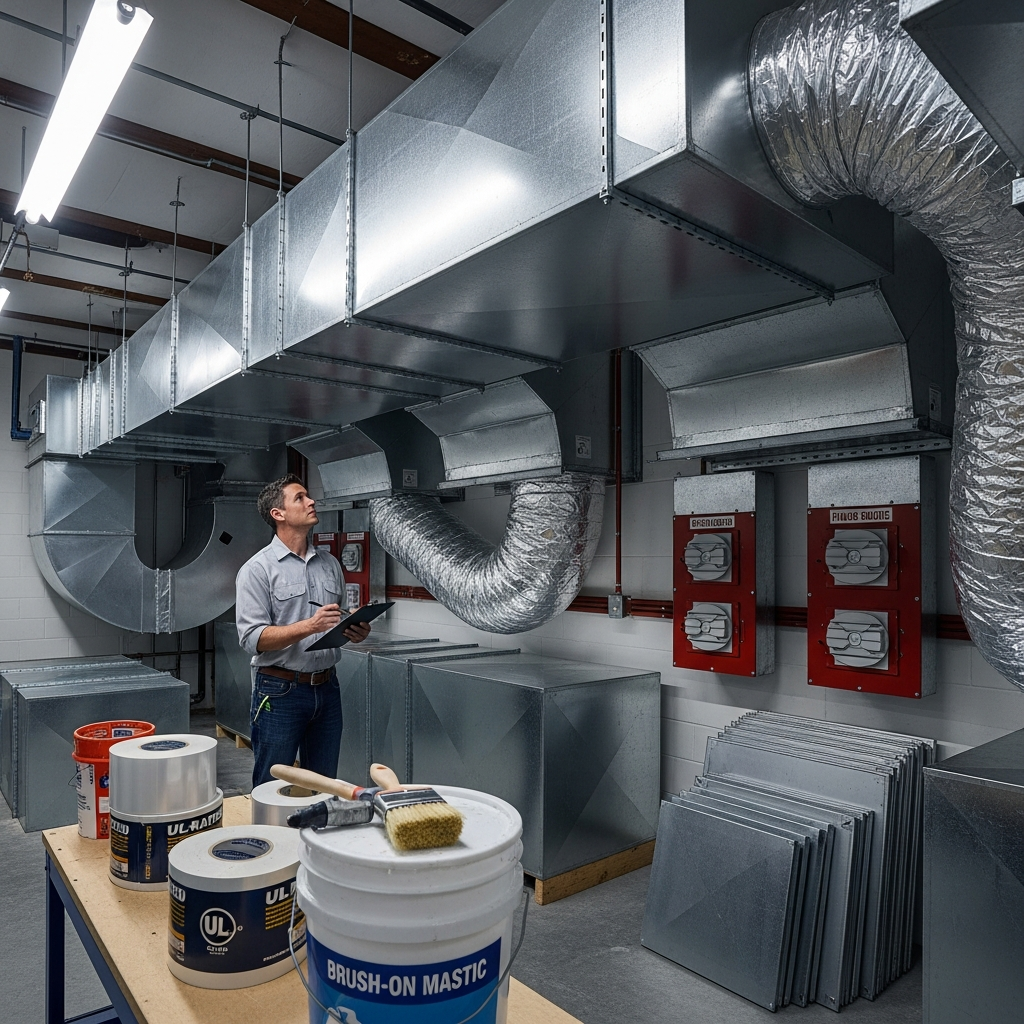
- Inventory Materials: UL 181 foil tape, water-based mastic, sheet metal screws, access doors, insulation, metal bands for flex, gaskets, and labeling supplies.
- Schedule Work Windows: Plan for after-hours or weekend work to minimize business disruption, especially in retail or clinical environments.
Physical Inspection Checklist
- Air Handler and Plenums: Check for panel gaps, degraded gaskets, filter rack bypass, and condensate management around cooling coils.
- Main Trunks: Look for failed tape at seams, loose transverse joints, pinhole corrosion, and unsealed takeoffs.
- Branch Ducts: Identify crushed or overly long flexible runs, excessive elbows, and unsupported spans that sag or vibrate.
- Fire/Smoke Dampers: Verify accessibility for inspection and confirm blades fully open when commanded. Note any obstructions or missing labels.
- Insulation: Inspect exposed supply ducts in unconditioned spaces. Replace torn jackets and re-tape seams to maintain thermal integrity.
- Boots and Diffusers: Seal boot-to-ceiling/wall gaps and ensure diffusers are secured, clean, and free of obstructions.
- Returns: Examine return drops and grilles for dust trails indicating leaks. Pay attention to returns near loading docks or storage areas where air quality can be compromised.
- Controls and Dampers: Document manual damper positions, zone actuator function, and any stuck or failed linkages.
Repair and Sealing Actions
- Secure Joints: Re-seat disconnected metal joints and fasten with sheet metal screws in a triangular pattern for rigidity.
- Apply Mastic: Brush a continuous layer over seams, takeoffs, and screw heads. Use mesh where gaps are wider before adding a top coat.
- Use Foil Tape Strategically: On long straight seams or where mastic access is limited, apply UL 181 foil tape and squeegee firmly to eliminate wrinkles.
- Rehabilitate Flex Duct: Cut back to intact liner, re-clamp to collars with metal bands, seal with mastic, and restore insulation and vapor jacket.
- Install Access Doors: Add code-compliant access to key locations for future cleaning and inspection without dismantling long runs.
- Seal Filter Racks: Gasket around racks and doors to stop unfiltered bypass that soils coils and duct interiors.
- Insulate: Re-wrap exposed supply runs and repair any compression points to keep surface temperatures stable and prevent condensation.
- Boot and Ceiling Interface: Seal gaps between boots and ceiling tiles or gypsum board with mastic or foam to prevent plenum air leakage.
Mid-Project Verification
Midway through, validate progress before proceeding to remaining zones. Compare baseline and current readings from anemometers at representative diffusers, and log static pressure upstream and downstream of critical components. Review BMS alarms and trends to see if supply temperatures and fan speeds are stabilizing as leakage declines. Speak with tenant contacts to confirm that noise, drafts, or odors have diminished.
Where stubborn issues persist—such as zones that still underperform due to long runs or oversized spaces—consider minor reconfigurations or balancing. If necessary, coordinate with a service provider skilled in air duct repair to advise on damper placement, branch resizing, or diffuser selection that aligns with occupancy patterns.
Testing, Adjusting, and Balancing (TAB) Essentials
- Airflow Measurement: Use a capture hood or anemometer grid at diffusers to quantify changes and identify outliers.
- Static Pressure Profiling: Measure at the blower inlet/outlet, across filters, and at critical branch points to ensure fan operation within design limits.
- Temperature and Humidity: Track supply air temperature and relative humidity to confirm proper heat transfer and dehumidification after sealing.
- Damper Position Records: Catalog final damper settings and label handles for quick future reference.
- Noise and Vibration: After sealing, re-check for panel buzz or duct rumble; add additional fasteners or acoustic liners where appropriate.
Documentation and Compliance
Businesses benefit from robust documentation. Create a repair log with photos of before/after conditions at each zone, lists of materials used, and test results. Update floor plans to reflect any re-routing and document damper positions. This information is invaluable during maintenance turnover, tenant improvements, and safety inspections.
For clinics, food service, or laboratories, maintaining positive or negative pressure relationships is essential. After sealing, re-verify pressure cascades to ensure compliance with internal policies and external standards that apply to your operation. Confirm that fire/smoke dampers remain accessible and that labels meet inspection requirements.
Preventive Maintenance for Commercial Ducts
- Quarterly visual checks of plenums, trunks, and returns, with special attention to high-traffic ceilings and rooftop curbs.
- Filter maintenance schedules aligned with occupancy and environmental loads; always seal rack bypass.
- Biannual inspection of insulation jackets and re-taping of exposed seams.
- Rapid response to roof leaks or condensation events to prevent microbial growth in adjacent ducts.
- Annual TAB spot checks in representative zones to maintain balance after tenant changes.
- Training sessions for on-site staff to identify early signs of leakage or vibration-related wear.
Frequently Asked Questions
Q: How disruptive is commercial duct repair? A: With proper planning, most tasks occur during off-hours, and tenants experience minimal noise or access interruption. Clear communication and phased work reduce disruption.
Q: Do sealed ducts require different fan settings? A: Sealing can alter static pressure. Verify that fans and VFDs operate within intended ranges and adjust setpoints or damper positions as needed during TAB.
Q: Are access doors necessary? A: Yes. Strategically placed access improves the speed and safety of future cleaning, inspection, and damper adjustments.
Q: What about rooftop units in winter? A: Plan repairs for milder weather when possible, and ensure safe access, de-energization, and proper sealing/insulation around curbs to avoid condensation and heat loss.
Q: Can our maintenance staff perform these repairs? A: Many repairs are well within maintenance capabilities. For complex systems, involve a specialist for testing, balancing, and compliance documentation.
Strengthen Comfort and Confidence in Your Workplace
Using a structured checklist ensures consistent, auditable duct repairs that reduce complaints, support healthy indoor air, and protect your equipment investment. From sealing return leaks to installing access doors and documenting damper settings, each step moves your building toward predictable comfort and performance.
If you prefer expert validation or need help across multiple tenant zones, collaborate with a local team focused on air duct repair. Planned, well-documented improvements today keep your workspace comfortable, productive, and resilient through every New Jersey season.
