Introduction
When you hire a qualified team for professional dryer vent installation in Somerville, New Jersey, you invest in safety, performance, and reliability. A carefully routed and sealed metal duct protects your home from the hazards of lint buildup and moisture while helping your dryer run efficiently. Professional installers bring specialized tools, a deep understanding of building assemblies, and the ability to make clean penetrations through brick, siding, or other exterior finishes. If you are considering upgrading an older vent or building a new laundry space, consult local experts in dryer vent installation so your project starts on a solid foundation.
Dryer vents are easy to underestimate. A poorly designed vent can lengthen drying times, increase wear on your appliance, and raise safety risks. Professionals know how to plan routes that minimize elbows, maintain proper pitch, and meet manufacturer specifications for diameter and length. They also prioritize durable terminations that keep out pests and weather while allowing unrestricted airflow. In a town with homes ranging from historic to newly built, a custom approach is critical; no two routes are identical, and each home deserves a vent configuration that suits its structure.
Why Professional Installation Matters
Professional installers streamline the process from planning to testing. They start by assessing the dryer’s location, the existing venting (if any), and the most direct path to the exterior. They consider structural elements—joists, beams, blocking, and utilities—to avoid conflicts. Then they design with rigid metal duct, long-radius elbows, and accessible connection points that can be disassembled for cleaning. Instead of improvised adapters or thin flex duct, you get a system built for long-term performance.
Beyond routing, professionals ensure a tight, safe penetration through the building envelope. That includes cutting clean openings, protecting the wall assembly with proper flashing, and installing an exterior hood with a smooth, freely moving damper. Every seam is sealed with UL-listed foil tape, supports are positioned to prevent sagging, and clearances are respected. After installation, airflow is tested to confirm that the system performs as expected.
What to Expect During a Professional Visit
A typical appointment begins with a site survey. The technician verifies the dryer model, confirms the required duct diameter, and inspects the space behind and around the appliance. They evaluate existing ducts to determine whether replacement or partial reuse is appropriate; in many cases, replacing older, lint-roughened ducts is the smarter choice. The route is measured and marked, and the termination location is selected for a straight shot and easy maintenance access.
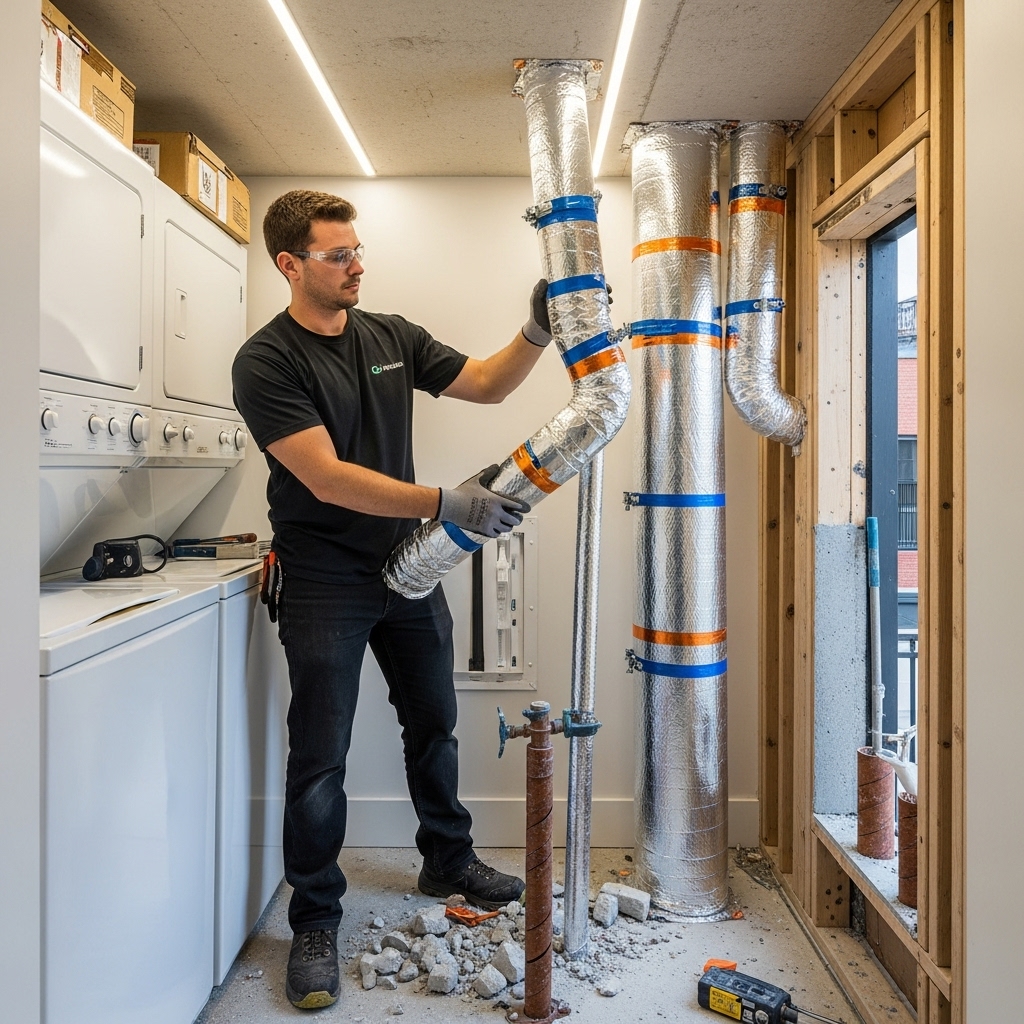
Next, the crew prepares the work area by moving the dryer, protecting floors, and clearing storage around the laundry. They cut the interior and exterior openings, ensuring no hidden wiring or plumbing lies in the path. The exterior hood is test-fitted and flashed. Duct sections are assembled with the male ends facing the airflow direction, elbows are positioned to create gentle turns, and supports are installed at regular intervals. The connection behind the dryer is made with a smooth, serviceable transition to allow maintenance. Finally, the system is tested—both inside and outside—to verify strong airflow and proper damper operation.
Materials and Components Professionals Prefer
Quality materials make the difference. Professionals select rigid aluminum or galvanized steel duct for the main run, semi-rigid aluminum only for the short transition behind the dryer when necessary, and high-grade exterior hoods with low-resistance dampers. They use UL-listed foil tape at seams and heavy-duty band clamps at service connections. Long-radius elbows reduce drag. Where the duct passes through walls, sleeves and collars protect edges and simplify future disassembly. All components are chosen to resist corrosion, withstand temperature changes, and maintain smooth interior surfaces that discourage lint accumulation.
In Somerville’s climate, installers also pay attention to condensation control. A slight pitch toward the exterior helps any incidental moisture move out. For ducts that pass through unconditioned spaces, careful routing and support reduce cold spots where condensation could form. The termination is placed to minimize wind interference and to stay free of landscaping obstructions.
Local Nuances in Somerville Homes
Somerville’s housing stock includes older masonry homes, mid-century renovations, and newer townhomes with compact mechanical chases. Professionals tailor the route to each scenario. In masonry, core drilling creates a neat opening and a durable sleeve, while in framed walls, the focus is on clean cuts, proper blocking, and effective sealing. Tight laundry closets benefit from recessed dryer boxes that preserve duct diameter without crushing. Multi-story townhomes may require strategic elbow placement to stay within effective length limits. In each case, the result is a vent that is accessible for cleaning and robust enough to stand up to daily use.
Benefits of a Professionally Installed Vent
The advantages extend beyond the day of installation. Drying times often drop because air moves more freely. The dryer runs cooler and lasts longer because it is not straining against a restricted exhaust. Indoor humidity near the laundry decreases, also reducing the risk of mold growth. Maintenance becomes simpler because joints are accessible and the route is documented. A neat exterior termination with a balanced damper looks better on your facade and functions reliably in all seasons. These practical benefits translate into a safer, more comfortable home and a laundry routine you can trust.
Professionals also provide accountability. With a documented route and clear workmanship, you know whom to call if you notice a change in performance. They can return for routine cleanings with the advantage of having installed the system, saving time and minimizing disruption. They can also advise on post-installation care and the signs that cleaning is due.
Mid-Project Decisions and Upgrades
During installation, an experienced technician may recommend changes that improve performance: a different elbow arrangement to shorten effective length, a recessed box for space-limited laundry closets, or an upgraded exterior hood that opens with less resistance in windy conditions. If you are replacing a very old vent, the team may suggest eliminating unnecessary joints or replacing rough, lint-laden sections instead of trying to salvage them. Clear communication ensures you understand the reasons behind adjustments and the expected benefits.
For homeowners who want to integrate better maintenance habits, the installer can demonstrate how to safely detach the transition connection behind the dryer for periodic cleaning. They can show you how the damper moves and what it should look like when functioning normally. These small lessons help you keep the system performing as designed.
Middle-of-the-Process Guidance
If you paused a DIY attempt due to unexpected obstructions or tough exterior materials, professionals can step in, evaluate your partial progress, and complete the job to a high standard. With the right tools and experience, they can rapidly achieve the clean cuts and sealed joints you were aiming for. If you need help deciding on the best termination or routing choice, reach out to a trusted provider of dryer vent installation for a practical plan that preserves airflow and simplifies maintenance.
Maintenance After Professional Installation
Even the best installation requires periodic cleaning. Lint is inevitable in laundry, and its accumulation depends on fabric types, frequency of use, and the route’s complexity. After a professional install, schedule routine cleanings, typically annually, and check the exterior hood seasonally. Keep the area behind the dryer free of clutter to preserve airflow and reduce dust. If you notice longer drying times, a hotter-than-usual laundry room, or a damper that barely opens, contact your installer to inspect and clean the system.
Keep simple records: the date of installation, route length, number of elbows, and photos of key connections. This information helps future service go faster and ensures that any changes over time are easy to recognize and address.
Frequently Asked Questions
Question: What kind of duct should be used for a professional installation? Answer: Rigid metal duct is the standard for the main run. It offers smooth interiors, durability, and better airflow than flexible options. Semi-rigid aluminum may be used for the short connection behind the dryer when movement is required.
Question: How do professionals ensure code compliance? Answer: They follow manufacturer specifications for duct diameter and length, avoid interior screws, use appropriate terminations without screens, and discharge outdoors. They also protect penetrations against water and verify airflow at completion.
Question: Can a roof termination be as effective as a wall termination? Answer: Yes, when designed for dryer exhaust and installed properly. Roof terminations must allow low-resistance airflow and be accessible for cleaning. In many cases, a nearby wall termination is simpler and easier to maintain.
Question: How often should I schedule cleaning? Answer: Typically once a year, but households with heavy laundry loads, pet hair, or long runs may need more frequent service. Watch for signs like longer cycles or a damper that barely opens.
Question: What if my current vent uses plastic or vinyl? Answer: It should be replaced. Plastic and thin vinyl-like vents are prone to crushing and trapping lint. Upgrading to rigid metal reduces risk and improves performance.
Question: Will a professional installation reduce drying time? Answer: In most cases, yes. A shorter, straighter route with smooth metal interiors allows air to move more freely, helping fabrics dry faster and reducing strain on the appliance.
Move Forward with Confidence
When you want dependable results, partner with a local team that specializes in dryer vent installation across Somerville. You will gain a safer, better-performing system, a cleaner exterior finish, and the reassurance that your laundry setup is built for long-term reliability.
