
Experience teaches every homeowner the same lesson: your HVAC is only as good as the ducts that distribute its air. In Somerville, New Jersey, where winters can bite and summers stay humid, well-sealed, well-supported ducts are the difference between even comfort and constant frustration. This expert-level guide compiles field-tested techniques for diagnosing, repairing, and verifying duct performance—without compromising safety or code compliance. If you prefer to start with a pro-level assessment, tap qualified air duct repair experts who can pressure-test and balance your system with specialized tools.
Advanced does not mean complicated. It means deliberate. Each tip below is about doing the right step in the right order so your fixes last through Somerville’s freeze-thaw cycles and humid spells. You will learn how to choose the correct sealants, prepare surfaces, correct flex duct geometry, and confirm success with simple instruments and common sense.
Start with system context: equipment, layout, and load
Expert repairs begin with a map. Sketch your system: air handler or furnace location, supply trunk paths, branch runs, return pathways, and register locations. Note duct sizes and materials. Identify long runs, tight bends, and “problem rooms.” Understanding layout reveals why a distant bedroom starves for air or why a central hallway roars with turbulence.
Consider equipment capacity and static pressure limits. Blowers are designed for specific pressure ranges. Leaks, kinks, and dirt all add up to higher resistance. If your readings (with a manometer) show total external static pressure near or above the manufacturer’s limit, prioritize removing restrictions: straighten kinks, restore crushed sections, and open blocked returns before adding new branches or registers.
Seal like a pro: material science matters
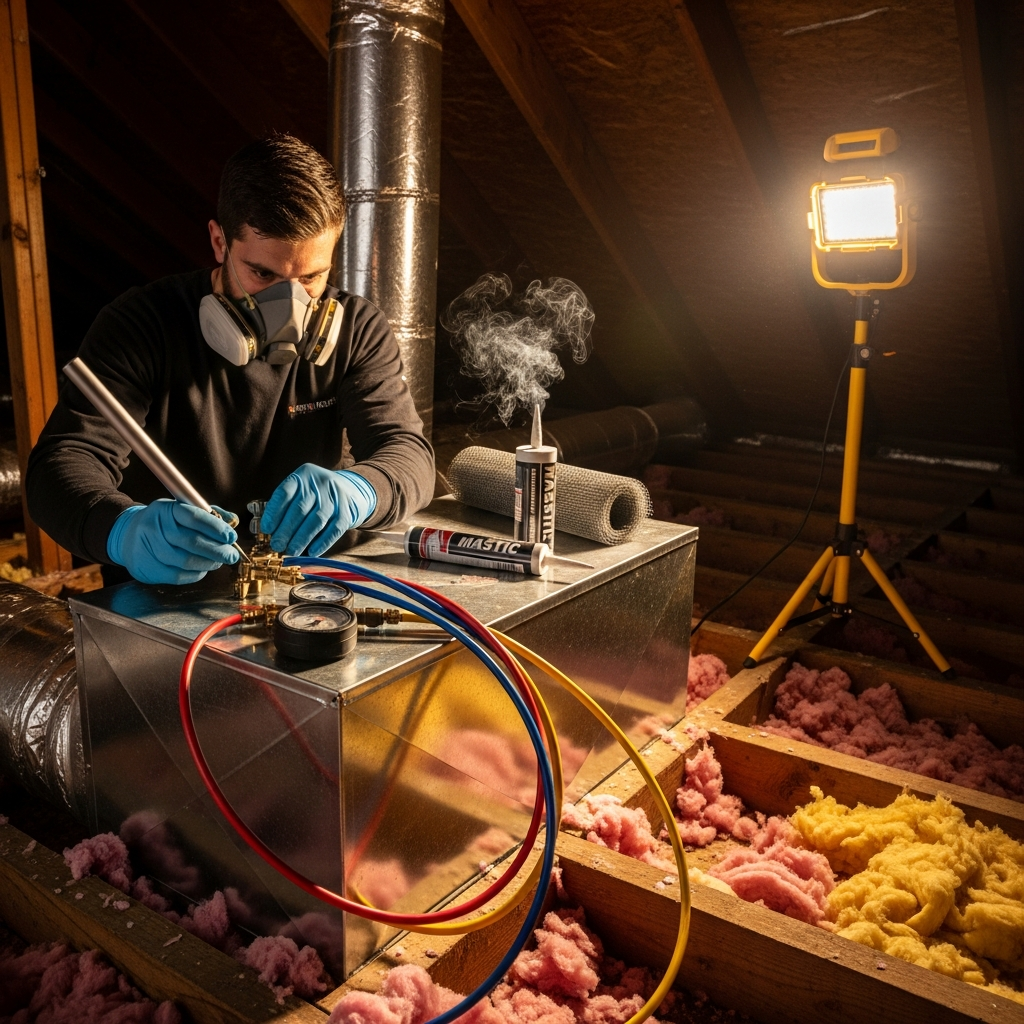
Use UL 181-rated duct mastic for irregular seams and transitions; its fiber-reinforced body adheres to galvanized steel and duct board and remains flexible as temperatures change. Apply with a chip brush and embed fiberglass mesh over gaps larger than 1/8 inch. For smooth, clean metal under moderate tension, UL 181 foil tape provides quick, clean results. Always clean surfaces first: wipe away dust, oil, and oxidation; mastic on dirt is decoration, not a seal.
Mind curing conditions. In unconditioned Somerville basements and attics, winter cold slows curing; summer humidity can condense on cold metal. Follow label temperature ranges, protect fresh seals from dust, and allow full cure before pressurizing the system. Do not use household tapes or caulks; they lack the temperature and pressure ratings ducts experience.
Flex duct geometry: the silent performance killer
Flex duct is easy to install and easy to compromise. Performance plummets when it is kinked, compressed, or left to sag. Maintain a straight, taut inner liner and support it every four feet with wide straps. Avoid stacking flex runs on attic trusses or storing boxes on top of them; compression increases friction dramatically. Where a turn is necessary, use a long radius—support the curve to prevent the inner liner from collapsing.
At collars, slide the inner liner fully over the bead, secure with a drawband, and add three evenly spaced screws through the collar into the helix if permitted. Seal with mastic or UL 181B tape. Pull the outer vapor barrier over the assembly and tape it separately so moisture does not reach cold metal and condense—a common summertime issue in New Jersey.
Boot-to-drywall and platform leaks: the hidden big ones
Even meticulous homeowners overlook the gap between supply boots and drywall or flooring. That gap leaks supply air into wall cavities and returns dust into rooms. Seal the boot perimeter to the finished surface with an appropriate sealant or metal-to-gypsum tape. At the air handler platform, check for holes, penetrations, and gaps around the filter rack; seal them so all return air passes through the filter.
Return plenums built from duct board often develop corner leaks as joints age. Recoat seams with mastic and reinforce with UL 181 tape. If the board is water-damaged or moldy, replacement is the correct move—porous materials do not clean well, and sealing over damage invites future problems.
Performance diagnostics: simple tools, powerful insight
You do not need a lab to get useful data. A manometer measures static pressure; aim for values within your blower’s rated range. An inexpensive anemometer can compare register flows across rooms; large discrepancies highlight restrictions or duct sizing mismatches. A smoke pencil reveals supply leaks and return infiltration. Together, these tools turn guesswork into a plan.
Temperature splits tell a story, too. In cooling, a typical delta-T across the coil may be around 15–20°F under normal humidity; in heating, consult equipment data. If your split is off and ducts are leaky, your system may be conditioning attics or crawlspaces instead of your rooms. Seal first, then retest before adjusting refrigerant or gas settings.
Mid-project triage: when to pivot to a specialist
Some challenges exceed DIY scope—not because they are impossible, but because they demand specialized tools or access. If you hit inaccessible wall cavities, suspect asbestos, or see extensive mold, it is time to bring in help. Likewise, persistent comfort issues after corrective sealing suggest deeper distribution or sizing problems. At that juncture, coordinated air duct repair with duct pressurization and balancing delivers clarity and lasting results.
Moisture management for New Jersey seasons
Summer humidity and winter cold conspire against poorly insulated ducts. Supply ducts running through attics or unconditioned basements should be insulated to appropriate R-values with sealed vapor barriers. Any breach in the vapor jacket invites condensation when cool air flows. In winter, warm, moist indoor air contacting cold metal can also condense at leaks. Sealing air pathways first, then insulating, prevents both issues.
If you see rust, staining, or water spots near ducts, investigate roof and plumbing before blaming the HVAC. Water from above can mimic duct condensation. Once you address the source, restore insulation and reseal any joints disturbed during the fix.
Noise reduction through smarter duct details
Whistles and rumbles often trace back to leaks, high velocity through undersized branches, or abrupt transitions. Sealing leaks is step one. Step two is smoothing the airflow path: use longer-radius elbows, avoid sudden size changes, and keep takeoffs from trunks at appropriate angles. In older Somerville homes, creative remodels left tortuous runs feeding finished attics; straightening even a few feet of flex or upgrading a takeoff can quiet a room noticeably.
Loose dampers and rattling boots can also add noise. Tighten damper set screws, ensure blades move freely, and secure boots firmly to framing. After sealing, verify that registers are not inadvertently blocked by area rugs or furniture—restricted discharge can imitate duct noise.
Combustion safety and code mindfulness
In homes with gas appliances, returns must not pull air from garages or mechanical rooms in a way that could entrain fumes. Seal return penetrations carefully, and maintain required clearances around flues and draft hoods. Do not tape or mastic any moving or hot components. When in doubt, consult local code requirements; safety around combustion air and venting is non-negotiable.
Electrical clearances matter, too. Do not strap ducts over electrical junction boxes or compress wiring with hangers. If you encounter questionable wiring while accessing ducts, pause and have a licensed electrician correct it before you proceed.
Document and verify: the expert’s habit
Take photos before and after each fix, label ducts at key branches, and keep a simple diagram of the system. After sealing and supporting, retest: smoke, pressure, temperature, and airflow comparisons. Record your numbers. Over time, this log helps you spot trends like filters clogging faster than expected or a run that slowly sags and needs an extra support.
Frequently asked questions
What is the single most effective repair? Sealing return leaks—especially at the air handler and boot perimeters—often yields the biggest gains in cleanliness and comfort.
Is mastic messy? It can be. Wear gloves and use a chip brush. The durability is worth the cleanup, and mineral spirits are not usually required; follow the product label.
How tight should flex duct be stretched? Pull it taut enough to remove kinks without over-tensioning the helix. A gentle, straight line between supports is the goal.
Do registers need sealing? The boot-to-drywall or floor connection should be sealed. The register itself is a grille and does not need mastic—just ensure screws are snug and the damper functions.
Can I balance airflow myself? You can improve balance by opening or slightly closing branch dampers, but measure results. Large imbalances or persistent hot/cold rooms often require duct changes.
Why does my home dust up after repairs? Disturbing old ducts releases settled dust. Replace your filter, vacuum registers, and clean nearby floors. The effect should diminish quickly if returns are sealed.
How often should I reinspect? Seasonally, with a deeper check before peak heating and cooling. Look again after storms or renovations that might jostle ducts.
Turn expert tips into everyday comfort
With smart sequencing—seal first, support and straighten second, insulate and verify last—you can transform how your Somerville home feels in every season. For advanced diagnostics, inaccessible leaks, or balancing, partner with local pros and schedule reliable air duct repair services that deliver measured improvements you can feel and document.
