
A Complete Air Duct Installation Guide for Somerville, New Jersey Homes
Whether you are renovating a classic Somerville colonial or building out comfort upgrades in a newer townhouse, a well-designed duct system is central to consistent temperatures, quiet operation, and healthy indoor air. This guide walks through the end-to-end process for homeowners who want to understand each decision point and participate confidently in planning. If you are exploring local options for air duct installation, use this resource to frame conversations with your contractor and align the system with your goals.
Somerville’s climate brings humid summers and chilly winters, which means your duct system must excel at delivering both cooling and heating. Good design manages airflow across the whole envelope, ensuring that bedrooms, living rooms, home offices, and basements all receive appropriate supply air and have sufficient return capacity to breathe easily.
Step 1: Define Your Comfort and Air Quality Goals
Before drawings or measurements, clarify priorities. Do you need whisper-quiet bedrooms? Is a home office overheating in summer afternoons? Are you sensitive to dust and seeking better filtration? A clear set of goals informs duct sizing, diffuser selection, return placement, and filter choices.
Common goals include taming temperature swings in rooms with large windows, improving upstairs comfort during hot weather, managing winter drafts in older homes, and reducing noise near sleeping areas. Make a list and share it with your contractor so the design explicitly solves these issues.
Step 2: Evaluate the Home
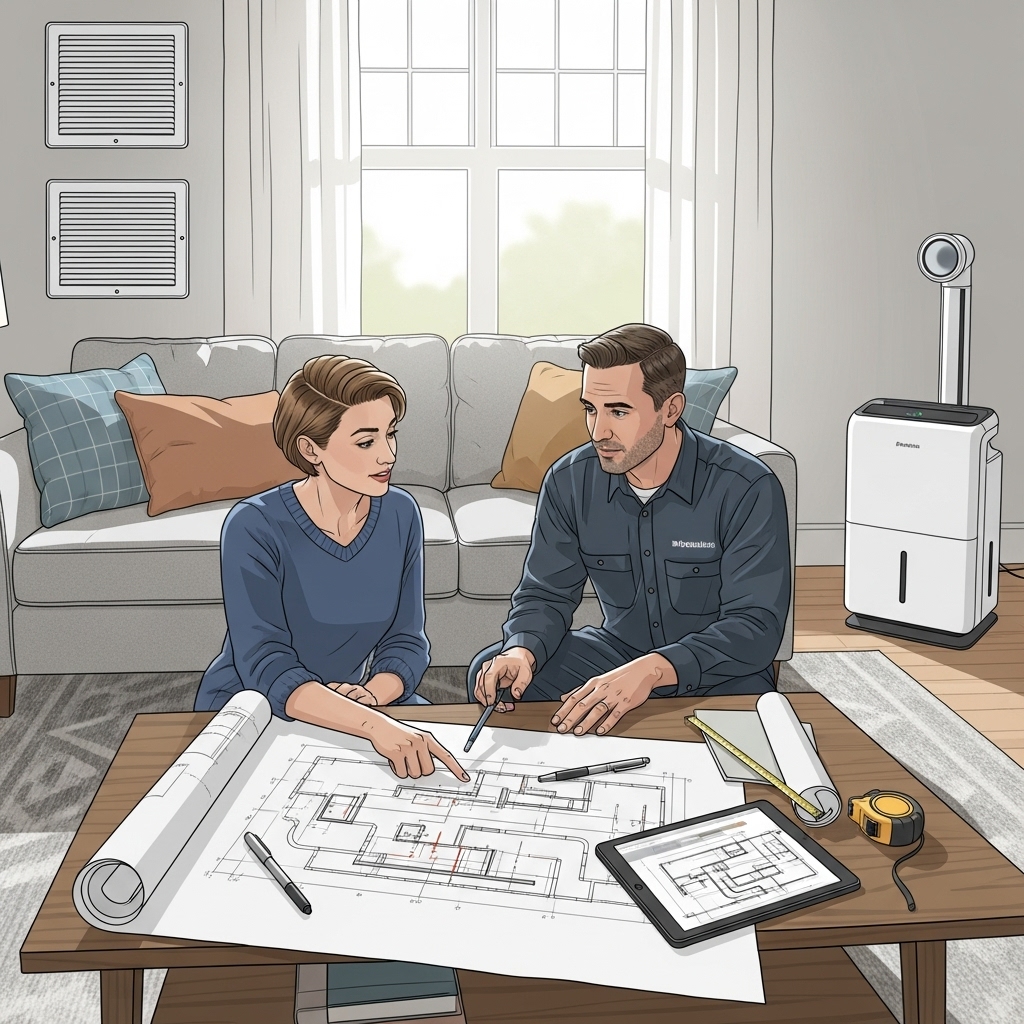
A thorough home assessment notes floor area, ceiling heights, insulation levels, existing duct pathways, attic and basement access, and any unusual framing details. The process typically includes measuring rooms, documenting window sizes and orientations, and mapping potential routes for trunks and branches. Where ceilings are low or attics are tight, the design may lean on oval ducts, shorter branch runs, or carefully placed soffits to preserve headroom and aesthetics.
Step 3: Perform Load Calculations and Duct Sizing
Accurate load calculations estimate how much heating and cooling each room needs, while duct sizing translates those loads into trunk and branch dimensions. Balanced sizing prioritizes adequate return area to protect against high static pressure and noise. This is especially important in retrofits of older homes, where original returns are often too small for modern comfort expectations.
Step 4: Choose Materials
Most installations combine a durable trunk—commonly sheet metal—with short, well-supported flexible branches. Duct board may be selected for specific runs where thermal or acoustic properties are desirable. The key is smooth airflow: minimize sharp bends, avoid overly long flex runs, and use proper supports at recommended intervals.
Step 5: Plan Supply and Return Placement
Supply registers should counteract room-specific challenges, such as solar heat gain from large windows or cold exterior walls. Returns must be strategically placed to keep pressure relationships healthy, especially with bedroom doors closed. Large homes or multi-level layouts benefit from dedicated returns per zone, reducing the chance of stale rooms and improving overall balance.
Step 6: Coordinate With Other Trades
Where projects coincide with electrical, plumbing, or structural work, coordination avoids clashes in joist bays and chases. Early alignment on routes and penetrations keeps the schedule on track and preserves aesthetics, especially if soffits are needed.
Step 7: Obtain Permits and Schedule Inspections
Work with your contractor to secure required permits and plan inspection milestones. Inspections verify that materials, clearances, supports, and penetrations meet standards. Proper documentation builds confidence in the system’s long-term safety and performance.
Step 8: Install Trunks and Branches
Installers begin with trunks, establishing the main pathways and transitions. Branches follow, kept as straight and short as possible. Flex runs should be pulled taut, gently curved, and supported at close intervals to prevent sagging. Metal transitions are sealed at every seam and joint to prevent leakage.
Step 9: Seal and Insulate Ducts
Sealing prevents conditioned air from escaping. Mastic or approved sealants are applied to joints, seams, and takeoffs. Insulation is essential in unconditioned attics, crawlspaces, and basements, keeping delivered air at the right temperature and avoiding condensation risk in humid weather.
Step 10: Install Registers, Grilles, and Dampers
Diffuser selection affects both airflow and sound. Adjustable registers allow modest tuning seasonally, and lined boots or sound-attenuating features can quiet the system in sensitive areas. Balancing dampers, accessible post-installation, are critical for tuning rooms that run a bit warm or cool compared to others.
Step 11: Test, Balance, and Commission
Commissioning confirms that real-world airflow matches design intent. Technicians measure static pressure, check airflow at key registers, and adjust balancing dampers. They confirm return performance and ensure that filter access is convenient and clearly explained to the homeowner.
Special Considerations for Somerville Homes
Older homes may feature plaster walls, ornate moldings, or narrow basements. A thoughtful plan maintains character while meeting modern comfort standards. Trunks can be routed through utility spaces, returns can utilize existing chases when properly sealed and lined, and soffits can be placed discretely to minimize visual impact.
In newer homes, opportunities for optimization include right-sizing returns to reduce noise, upgrading filter racks for better indoor air quality, and planning for smart zoning to keep upstairs and downstairs temperatures aligned on extreme days.
Noise Management
Noise control is a core design goal, especially for bedrooms and home offices. Strategies include generous return area, smooth transitions, flexible connectors near the air handler, lined boots, and register placement that avoids direct drafts in quiet spaces. Variable-speed fans can further reduce perceived noise by easing airflow rather than cycling at top speed.
Indoor Air Quality
High-quality filtration supports health and cleanliness. Filters must be sized for adequate surface area to keep airflow strong while capturing fine particles. Consider return placement that reduces dust accumulation and provides easy filter changes. If humidity is a concern in summer, whole-home dehumidification can integrate effectively with the duct system.
Attics, Basements, and Crawlspaces
Ducts in unconditioned areas need careful insulation and sealing to maintain delivered temperature. In attics, attention to vapor control and support spacing prevents sagging and condensation. In basements, plan routes that protect headroom and keep ducts accessible for future service. Crawlspaces require moisture management and secure supports to maintain integrity over time.
Registers and Aesthetics
Register choices influence both performance and appearance. Low-profile designs blend with modern interiors, while classic styles complement historic homes. Make selections early to avoid delays, and confirm finish colors that match hardware or trim. Correct placement avoids drafts on seating areas and directs air to mix naturally within the room.
Future-Proofing and Flexibility
Homes change as families grow and spaces are repurposed. Design with future flexibility so that additional returns, filtration upgrades, or zoning adjustments can be implemented later without major redesign. Accessible dampers and clear labeling of key runs make future modifications simpler and less disruptive.
Documentation You Should Expect
A professional installation includes a clear scope, material and insulation specifications, register locations, and a simple as-built schematic marking trunks, branches, and dampers. Commissioning notes should summarize static pressure readings and balancing adjustments, giving you a baseline for future maintenance checks.
Working With Your Contractor
Communication is essential. Share your comfort goals, confirm scheduling windows, and agree on protection for floors and finishes. Ask how discoveries behind walls will be handled and documented. A collaborative approach keeps surprises small and solutions aligned with your priorities.
Mid-Project Decisions
As walls open, you may face decisions about alternate routes or register placements. Choose the option that best supports airflow and service access, and that aligns with long-term aesthetics. If you need a quick second opinion, a Somerville pro specializing in air duct installation can help evaluate tradeoffs so the system performs to plan.
Maintenance Planning
Plan for filter changes with easy access and clear labeling. Establish a routine for inspecting visible duct runs, supports, and registers. Seasonal check-ins—particularly after the first summer and winter—help confirm that balancing remains optimal and that rooms feel as intended.
Frequently Asked Questions
Q: How long does a typical installation take? A: It depends on home size, layout complexity, and access. Straightforward projects can move quickly, while retrofits that require soffits or framing work take longer.
Q: What if my home has very low basement ceilings? A: Designers may use oval ducts, route trunks strategically, or create discrete soffits in less visible areas to preserve headroom where it matters most.
Q: Can I improve filtration without adding noise? A: Yes. Properly sized filter racks with sufficient surface area maintain airflow while capturing more particles, reducing the risk of increased static pressure and noise.
Q: Do I need separate zones? A: Many multi-level homes benefit from zoning to manage temperature differences between floors. The decision depends on layout, insulation, and comfort goals.
Q: What is commissioning? A: Commissioning is the testing and balancing phase that verifies airflow, static pressure, and overall performance match the design intent. It’s a key step in delivering comfort and efficiency.
Q: Will new ducts help with humidity? A: While ducts themselves don’t dehumidify, proper sealing and insulation prevent unwanted moisture problems, and the system can integrate dehumidification solutions that target summer humidity.
Get Your Somerville Duct Project Moving
With a thoughtful plan, careful installation, and proper commissioning, your home can enjoy even temperatures, quiet rooms, and healthier air across Somerville’s seasons. If you’re ready to discuss layouts, returns, insulation, and balancing, connect with local experts for air duct installation and take the next step toward a system designed specifically for your home.
